
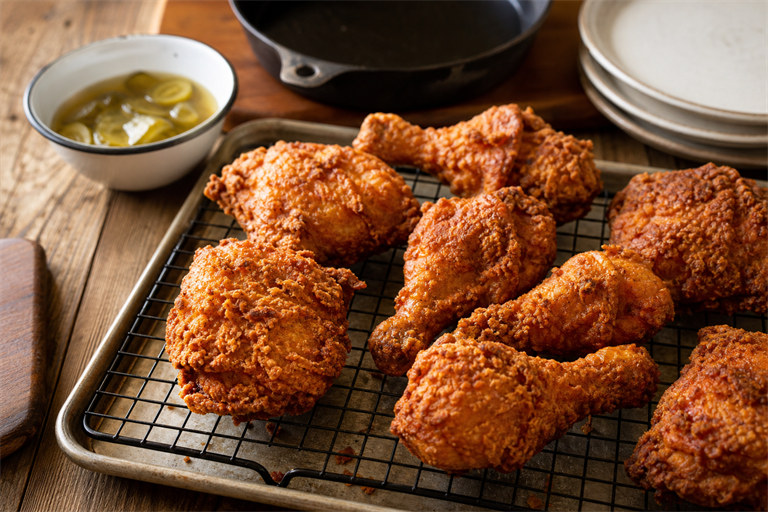
Fried chicken can have a brown coating and an undercooked center, or leave the pan crisp and become damp on the serving plate. Those problems need different corrections. Start by identifying when the problem appears, then check the oil temperature, the meat temperature, and the resting surface separately.
This guide accompanies our buttermilk fried chicken recipe. Keep that ingredient list unchanged while you diagnose a batch; changing the brine, flour blend, burner setting, and batch size together makes the result difficult to interpret.
First, check whether the chicken is cooked
A dark crust does not establish doneness. USDA recommends 165°F (74°C) for poultry. Check each piece before serving, including breasts. Do not depend on a predicted temperature rise during resting.
- Lift a piece from the oil with tongs onto a heatproof tray used for checking partially cooked chicken. Keep this separate from the serving platter.
- Insert an instant-read probe into the thickest meat, avoiding bone. On a breast, approaching from the side can help you reach the center without measuring mostly crust.
- Check another position in a large or irregular piece. Wait for the reading to stabilize according to the instrument’s instructions. If any checked area is below 165°F, continue cooking.
- Clean the probe after contact with undercooked chicken before checking cooked food. Transfer finished pieces to a clean rack.
The placement principle follows USDA’s thermometer guidance. A probe touching bone or sitting only beneath the coating does not measure the area you intended to check.
The coating is greasy as soon as it leaves the oil
Look at the frying thermometer before adding another batch. Did the oil recover after the last addition, or did you load more chicken while it was still cooling? For the linked recipe, work around 325°F (163°C) during frying. ThermoWorks also uses this frying target. It is an oil temperature, not a doneness temperature.
Try fewer pieces in the next batch and leave space between them. Position the oil probe as its manufacturer directs, with the sensing area submerged and clear of the pan. Adjust the burner gradually and watch the trend before making another adjustment. Turning it to maximum after every drop can produce a large overshoot once the pan catches up.
The crust is brown but the center is below 165°F
Stop using crust color as the stopping point. Check for oil running hotter than the recipe target and for unusually large pieces. A large breast and a small wing need individual temperature checks; they need not leave the pan together.
If further frying is scorching the coating, transfer the undercooked pieces to an oven-safe rack over a rimmed pan and continue cooking immediately in a preheated 350°F (177°C) oven. Check each piece until it reaches 165°F. This is a corrective finishing step, not a fixed-time shortcut. Do not refrigerate partially cooked chicken to finish later.
It was crisp in the pan but softened underneath
Inspect the landing area. Pieces piled together, tightly covered, or sitting directly on a plate have little room for steam to escape. Arrange them in one layer on a clean rack above a tray. Paper beneath the rack can catch drips without touching the crust. Jennifer Joyce’s Good Food recipe likewise uses a separate rack for cooked chicken.
Set out the rack before frying. Otherwise the first finished pieces may sit on a temporary plate while you handle the next batch. Sauce only the portions being served; a wet sauce changes the surface you just dried.
Make the next batch informative
Write down the cut, number of pieces, oil reading before loading, lowest reading after loading, and final meat reading. Add when the crust softened: in the oil, on the rack, or after covering. That short record gives you a specific adjustment next time instead of another complete recipe change.
Do not extend counter storage to preserve crunch. USDA’s leftover guidance calls for refrigeration within two hours, or one hour above 90°F (32°C). Reheat refrigerated leftovers to 165°F; a crisp surface alone does not confirm that the middle is hot enough.