
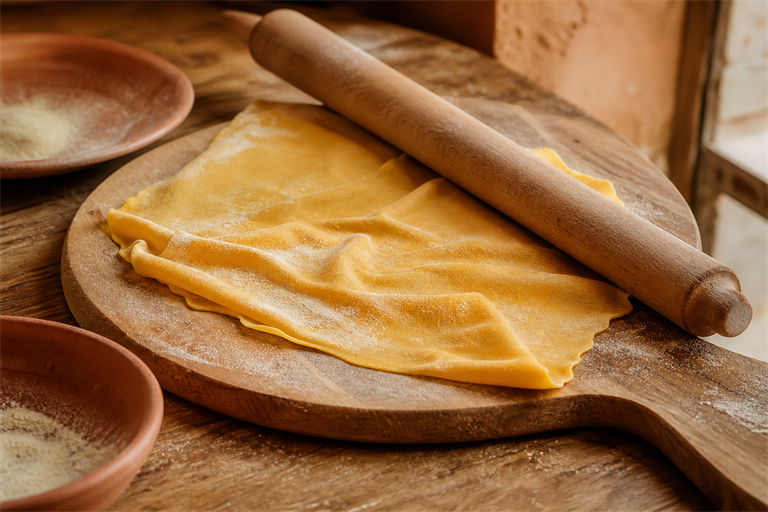

In Bologna, sfoglia traditionally goes on the board on Sunday mornings, often in kitchens above the bakeries along streets like Via Saragozza. A well-used board outlasts generations. The mattarello runs long enough to reach past the roller’s hips on both sides, and the room fills with the smell of warm flour and yolks cracked one-handed into a well on the wood. The tap of the fork against the shell is part of the rhythm.
Tagliatelle is the pasta of Emilia-Romagna. What the sfogline of Bologna call sfoglia tirata a mano means pasta pulled by hand, and the thing that separates a silky ribbon from a gummy one is not the recipe. It is learning to read the sheet as you stretch it.
A sfoglia for four, rolled on that kind of board, uses 400 g of Molino Pasini 00, 50 g of semola rimacinata, four large eggs and one extra yolk. The dough rests 45 minutes under an upturned bowl. A finished sheet lands at about 0.6 mm thick: translucent enough to read the newspaper underneath, just.
| Yield | 4 servings |
| Prep time | 30 minutes (plus 45 minutes rest) |
| Cook time | 90 seconds |
| Total time | 2 hours |
| Difficulty | Intermediate |
What you’ll mix into the well
- 400 g 00 flour (Italian soft wheat, low protein)
- 50 g semola rimacinata (finely milled durum)
- 4 large eggs at room temperature (about 60 g each, in shell)
- 1 extra large yolk
- A small bowl of semola for dusting the board and the ribbons
The Emilian rule is one egg per 100 g of flour. The extra yolk and the spoonful of semola give the classic bite: tender on the tongue, with a faint pull behind the teeth. All-purpose flour works, but the sheet tears more easily and the cooked pasta is softer.
Why the wooden board and the long pin matter
- A wooden board (tagliere) at least 60 × 80 cm. The porous surface grips the dough.
- A mattarello: a long, thin Italian rolling pin, 80 to 90 cm, with no handles.
- A bench scraper.
- A clean tea towel.
A standard rolling pin will not pull a thin enough sfoglia. A length of unfinished hardwood dowel from a hardware shop will, and that is still the tool of choice among Modenese cooks working the old way.
Building the dough, kneading, and the rest you cannot skip
Pour the 00 and semola onto the board and make a wide well in the centre. Crack the eggs and the extra yolk into the well. With a fork, beat the eggs, then start pulling flour in from the inside wall of the well, a little at a time, until you have a shaggy dough. Set the fork aside and work the rest in with your hands.
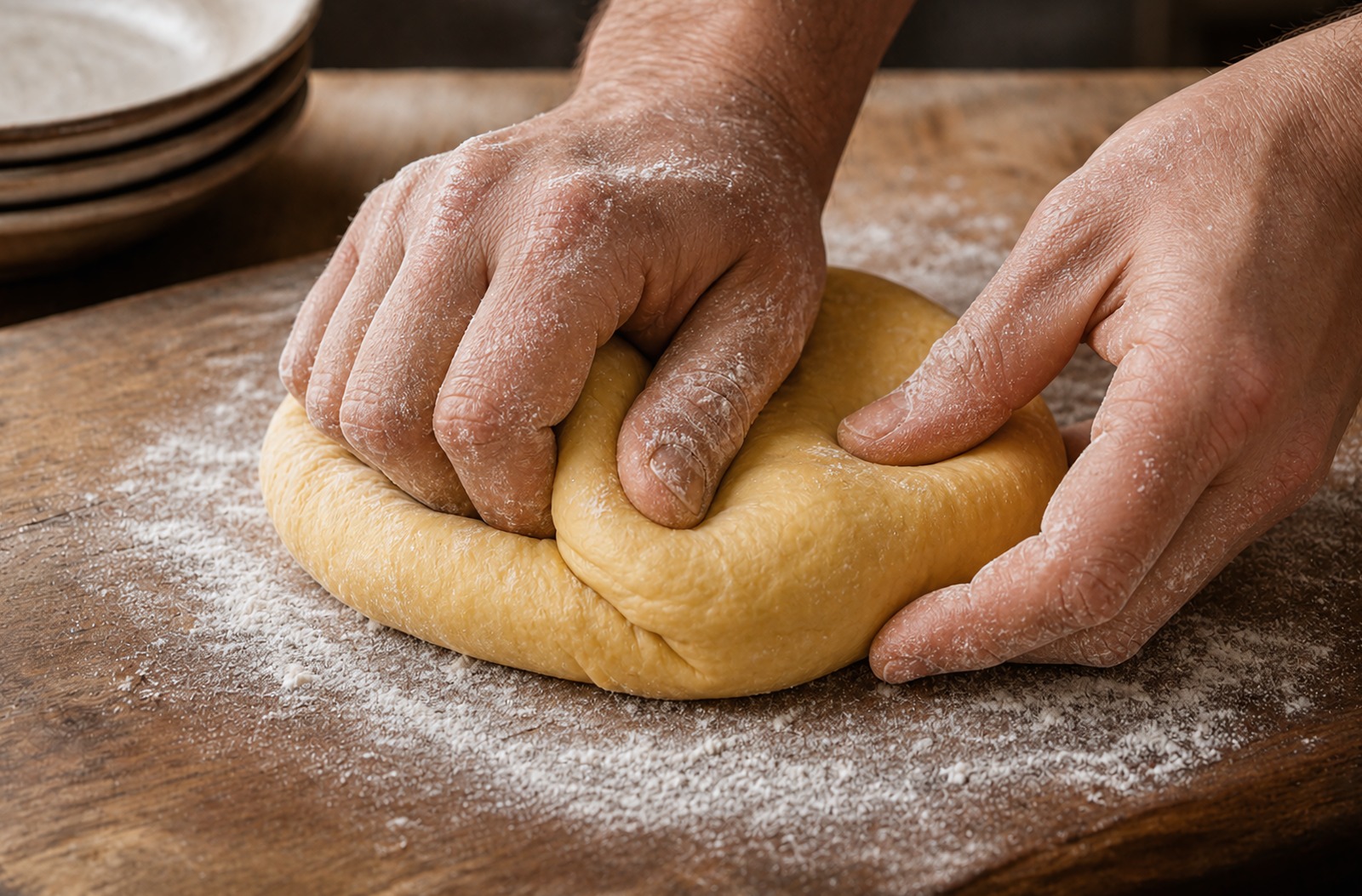
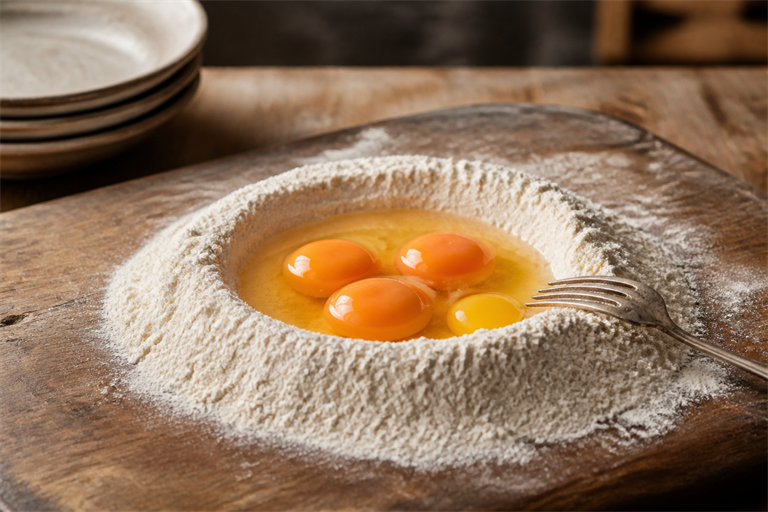
Knead for 10 to 12 minutes, pushing down and away with the heel of your hand, then folding the dough back over itself. The dough is ready when the surface goes from rough to smooth and faintly tacky, like the inside of an earlobe. If it sticks to the board, dust with a little more 00. If it cracks at the edges, wet your hands and keep going.
Wrap the dough tightly in cling film and rest it 45 minutes at room temperature. Thirty is not enough. The gluten needs time to relax, or the sheet will pull back on you while you roll and the tagliatelle will be tough.
Pulling the sfoglia: from disc to translucent sheet
Unwrap the dough and flatten it into a 2 cm disc on a lightly floured board. Place the mattarello across the centre and push it away from you with firm, even pressure, rotating the disc a quarter turn after each pass. Work outward from the centre every time. The point is to thin the dough evenly, not to squash it.
Once the sheet is around 3 mm thick, switch to the stretch motion. Wrap the far edge of the sfoglia loosely around the mattarello. Roll it toward you, dragging your palms outward along the pin as you roll back. This pulls the dough wider. Rotate a quarter turn and repeat. Dust the board with semola whenever the sheet starts to grip.
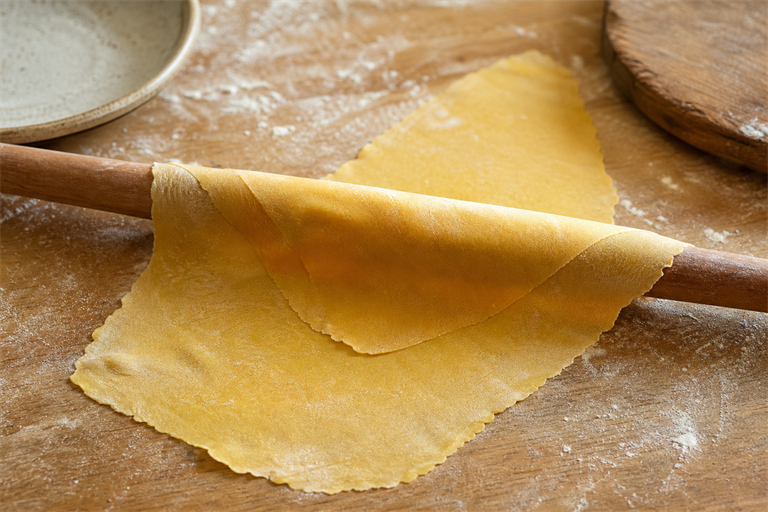
Stop when the sheet is around 0.6 mm thick. Lift a corner to the window; you should see the shape of your hand through it. The Bolognese test: lay the sheet over the back of your hand. If it drapes softly without tearing and you can read the lines on your palm through it, the sfoglia is ready.
Cutting the ribbons, and what counts as tagliatelle
Let the sfoglia rest on the board, uncovered, for 8 to 10 minutes. The surface should feel dry to the touch but still flexible. Dust it generously with semola, then fold it loosely in thirds like a letter, dusting between each fold so the layers do not stick.
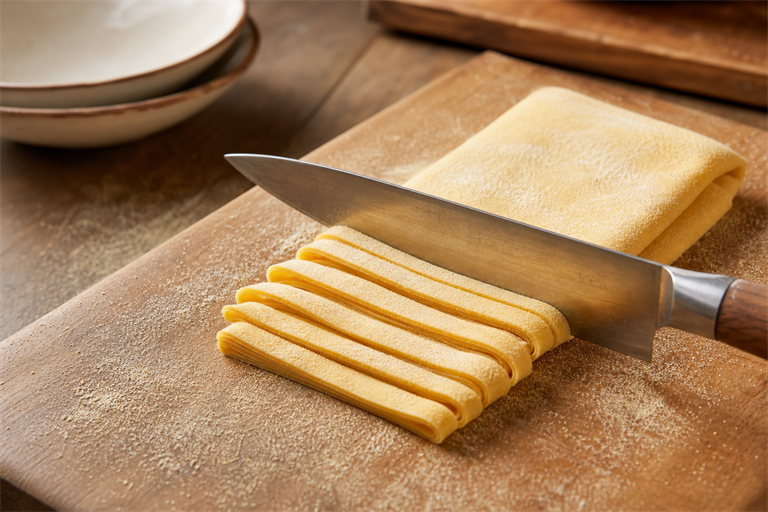
With a sharp knife, cut ribbons 7 mm wide across the folded sfoglia. Tagliatelle alla bolognese is officially 8 mm cooked, which works out to about 6 to 7 mm raw. Anything thinner is tagliolini. Anything wider belongs to a different sauce. Lift the cut ribbons, unfurl them with your fingers, and form loose nests on a tray dusted with semola. Do not stack them.
The 90 seconds at the stove
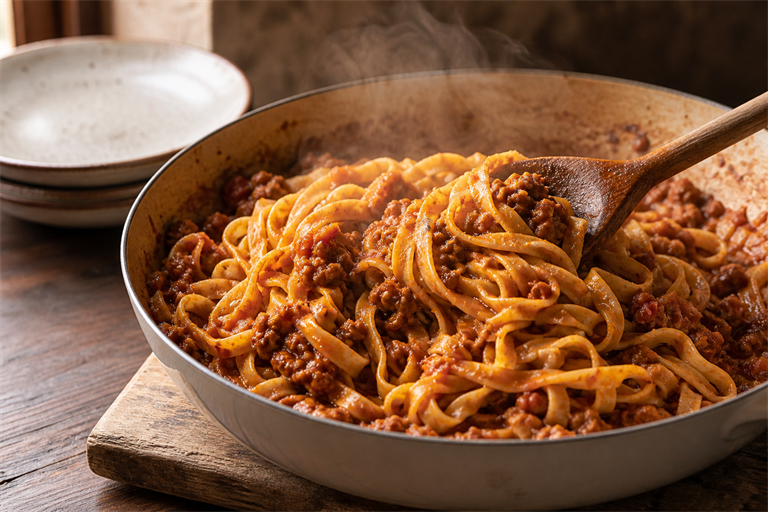
Bring 4 litres of water to a rolling boil and salt it with 30 g of coarse salt. Drop the nests in and stir once. Fresh tagliatelle cooks in 90 seconds; taste at 60. Lift with a spider straight into a warm pan of ragù, with a ladle of the cooking water to loosen the sauce. Toss for 20 seconds over low heat and serve at once.
Small things that change the outcome
If the sheet keeps shrinking back as you roll, the dough is under-rested. Cover it with the towel and walk away for ten minutes. It will go.
If your tagliatelle clumps in the pan, you skipped the semola dusting, or the cut ribbons sat too long without being separated. Semola, unlike 00, does not absorb back into the dough, which is precisely why it works as a dusting flour.
Humidity makes the dough tackier and more likely to cling to the pin. On a close August afternoon, crack a window and use a light extra veil of semola; in a dry winter kitchen, the sfoglia stays supple longer and needs less rest after rolling.
Leftover ribbons dry on a tea towel for two hours, then keep in a paper bag at room temperature for three days. Cook one minute longer.
The sfoglia for tortellini is rolled the same way but stopped at 0.4 mm. For tagliatelle you want a hair more body so the ribbon holds the ragù.
What goes on top, and what does not
In Bologna, tagliatelle goes with one of three things. Ragù simmered four hours, with milk before wine. Butter and sage with a snow of Parmigiano in late summer. Or a fresh porcini sauce in October. A glass of young Sangiovese di Romagna on the side, and bread on the table for the last of the sauce.
The Emilian tradition holds that tagliatelle was built to carry sauce, not to chase it. Cut it thick enough to hold the ragù, and never serve it with seafood. That belongs to the coast, and this belongs to the hills.