
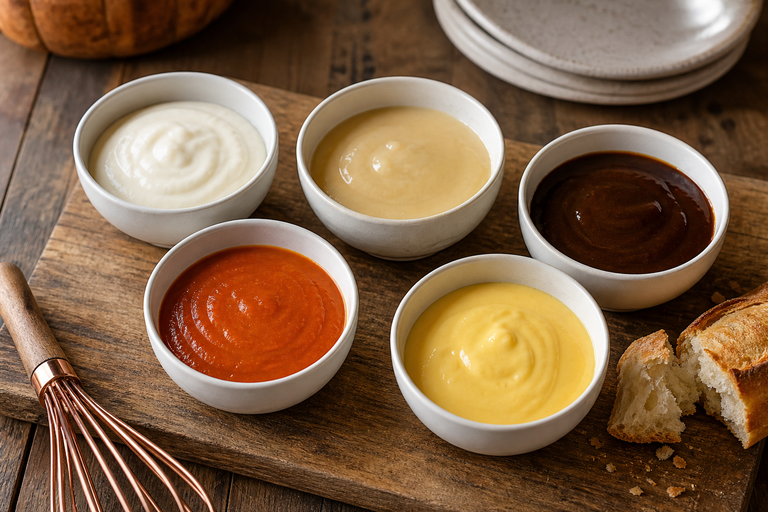

For a quick steak supper for two, picture the butcher’s counter near the Halles Paul Bocuse in Lyon: entrecôte in front, onglet just behind it. Bordelaise needs a cut with enough mineral depth to keep pace with the wine. In this style of cooking, the sauce is not simply a finish. It shapes the choice of meat from the start.
If you have ever opened a French recipe, read “finish with a sauce Mornay” or “nappé of suprême,” and felt locked out, the problem is not the dish. No one has handed you the map. The five mother sauces are that map. Learn them as a decision tree of liquid plus thickener, and roughly sixty named sauces stop being a memorization exercise. They start being a Tuesday-night choice.
The short version, stated up front: each of the five mother sauces is a base defined by one liquid paired with one thickening method. Béchamel is milk plus white roux. Velouté is light stock plus blond roux. Espagnole is brown stock plus brown roux. Tomate is tomato reduced and thickened by its own pulp (classically with a little roux and pork). Hollandaise is warm butter emulsified into egg yolk and acid. Every “daughter sauce” you meet in a French recipe is one of these five with two or three things added. Once you can build the mother, the daughters cost you five extra minutes and the contents of your fridge.
Why Carême and Escoffier organized sauces this way
The framework is not folklore. Marie-Antoine Carême, writing in the 1830s in L’Art de la cuisine française au dix-neuvième siècle, was the first to group French sauces under four “grandes sauces”: espagnole, velouté, allemande, and béchamel. He did it because the kitchens he ran at Talleyrand’s table and in the British royal household were producing dozens of sauces a night, and the only way to train a brigade was to teach the base once and the variations after.
Auguste Escoffier, in Le Guide culinaire (1903), reworked the list. He moved allemande into the velouté family as a derivative, added sauce tomate as a base in its own right, and promoted hollandaise from a butter sauce into the fifth mother. That is the list home cooks still inherit: béchamel, velouté, espagnole, tomate, hollandaise. The logic was the same as Carême’s. Organize by base, not by dish, and a cook learns five things instead of fifty.
The five mother sauces at a glance
Use this table as a quick map from liquid and thickener to the finished sauce.
| Mother sauce | Liquid | Thickener | Cook time | Classical use |
|---|---|---|---|---|
| Béchamel | Whole milk (500 ml per 30 g flour) | White roux (equal butter and flour, cooked 2–3 min without colour) | 15–20 min | Gratins, lasagna, croque-monsieur |
| Velouté | Light stock (chicken, veal, or fish; 500 ml per 30 g flour) | Blond roux (cooked 4–5 min to pale gold) | 25–30 min | Poached poultry, fish, vol-au-vent |
| Espagnole | Brown veal stock (1 L reduced) | Brown roux (cooked 8–10 min to hazelnut) plus mirepoix and tomato paste | 2–4 hours | Braises, red meat, demi-glace |
| Tomate | Tomato (1 kg fresh or 800 g tinned San Marzano) | Pork (salt pork or pancetta), light roux, long reduction | 1.5–2 hours | Pasta, eggs, poached meats |
| Hollandaise | Clarified butter (250 g) | Egg yolk (3) emulsified with lemon juice and a vinegar reduction | 10 min | Eggs, asparagus, poached fish |
Read the table as a decision, not a list. The liquid in your pan and the thickener in your hand decide the sauce before you have named it.
Béchamel and its family: milk plus roux
A béchamel is the easiest mother to learn and the easiest to ruin. Melt 30 g of butter, whisk in 30 g of flour, and cook the paste over medium-low heat for two to three minutes without letting it colour. Pour in 500 ml of warm whole milk in three additions, whisking each time until smooth. Simmer for 8 to 10 minutes, then season with salt, white pepper, and a single rasp of nutmeg.
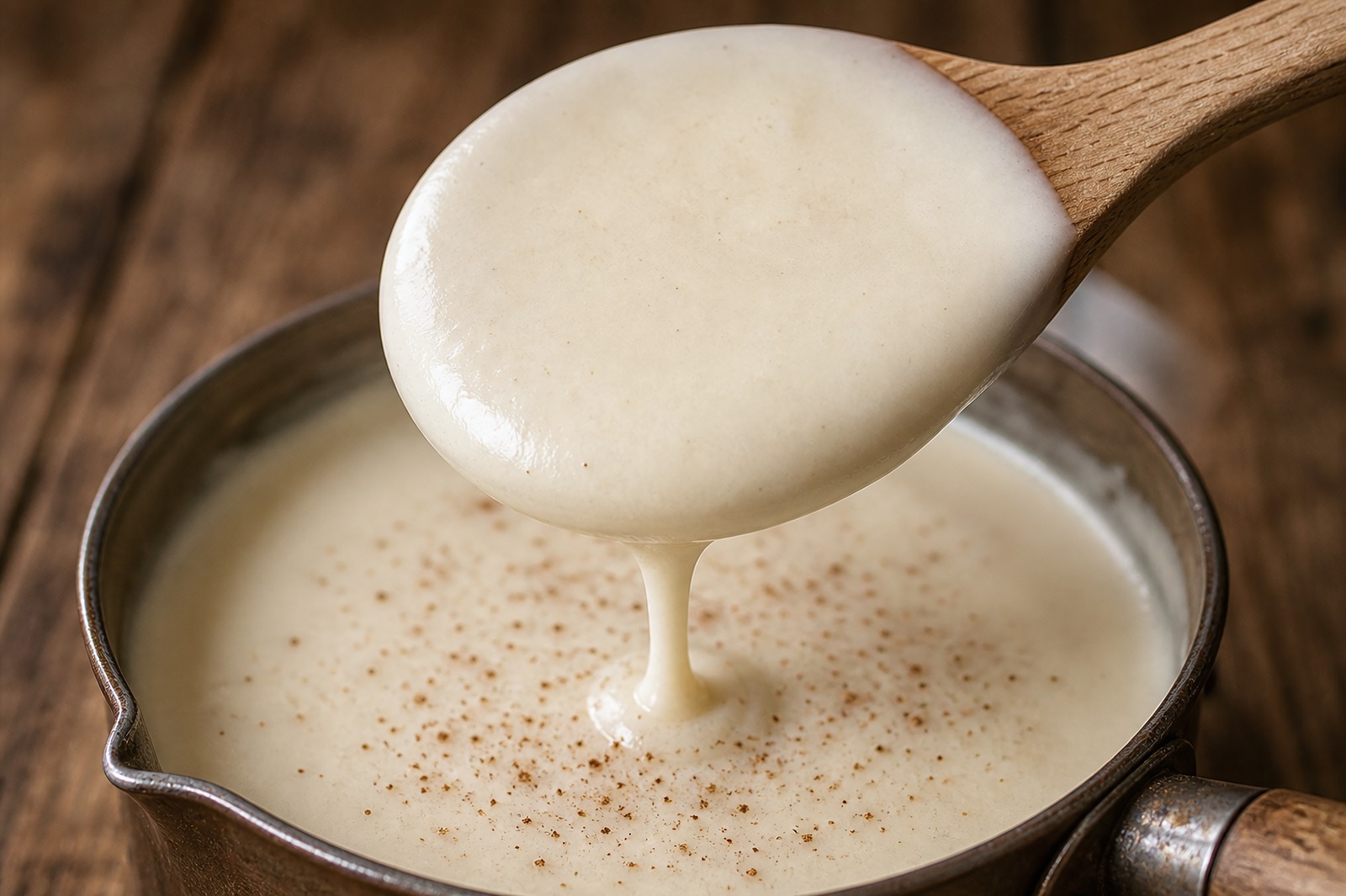
That is the base for half of what people think of as “French comfort cooking.” Stir in 60 g of grated Gruyère and 30 g of Parmesan off the heat and you have a Mornay, which binds a gratin dauphinois or croque-monsieur. Fold in a purée of slowly stewed onion and you have a Soubise for roast lamb. Whisk in a reduction of crayfish butter and you have a Nantua, whose rich shellfish note suits Lyon-style quenelles.
Velouté: light stock plus blond roux
Velouté is béchamel’s sibling. Same roux, different liquid. Use a good chicken or fish stock instead of milk, cook the roux a little longer to a pale gold, and you have the base for every elegant pan sauce in the French repertoire. The classic finishes are three. Allemande, lifted with a liaison of egg yolk and cream, dresses poached chicken. Suprême, enriched with cream and a squeeze of lemon, is the sauce around a chicken breast at a Sunday lunch. Bercy, mounted with shallots, white wine, and butter, is what you spoon over a piece of sole or any delicate white fish that needs a sauce rather than a steam.
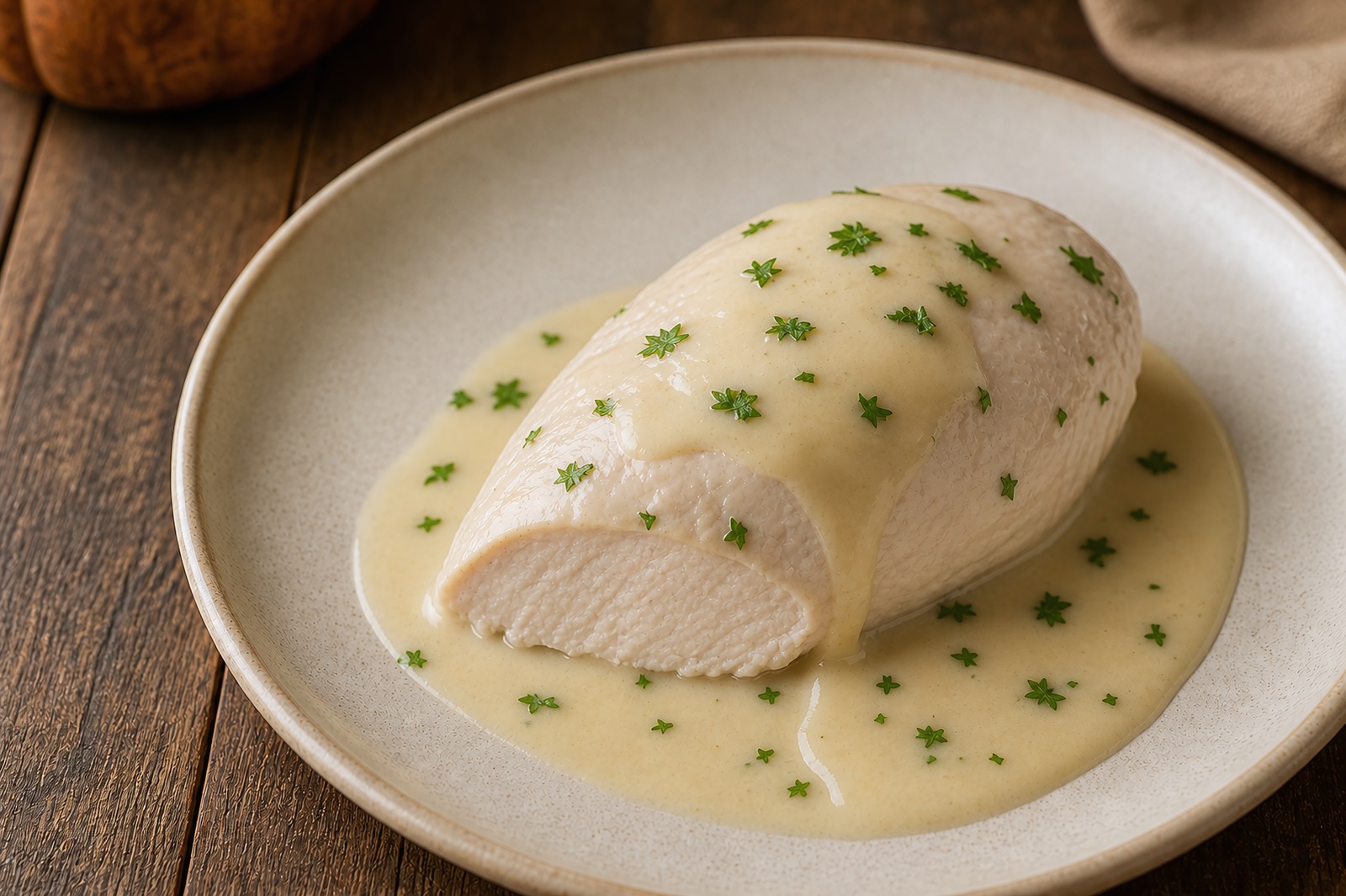
If you cook chicken on a weeknight, this is the family that earns its place. Sear the chicken, build the velouté in the same pan with the stock and the fond, and you have a pan sauce in fifteen minutes that tastes like a bistro.
Espagnole: brown stock plus brown roux
Espagnole is the long sauce, and it is the one home cooks skip. Carême’s original took a full day. Escoffier’s takes three to four hours: brown veal bones and mirepoix, cook a roux to deep hazelnut, add tomato paste, moisten with brown stock, and simmer with skimming until it coats a spoon. Reduce it again with more stock and you have demi-glace.
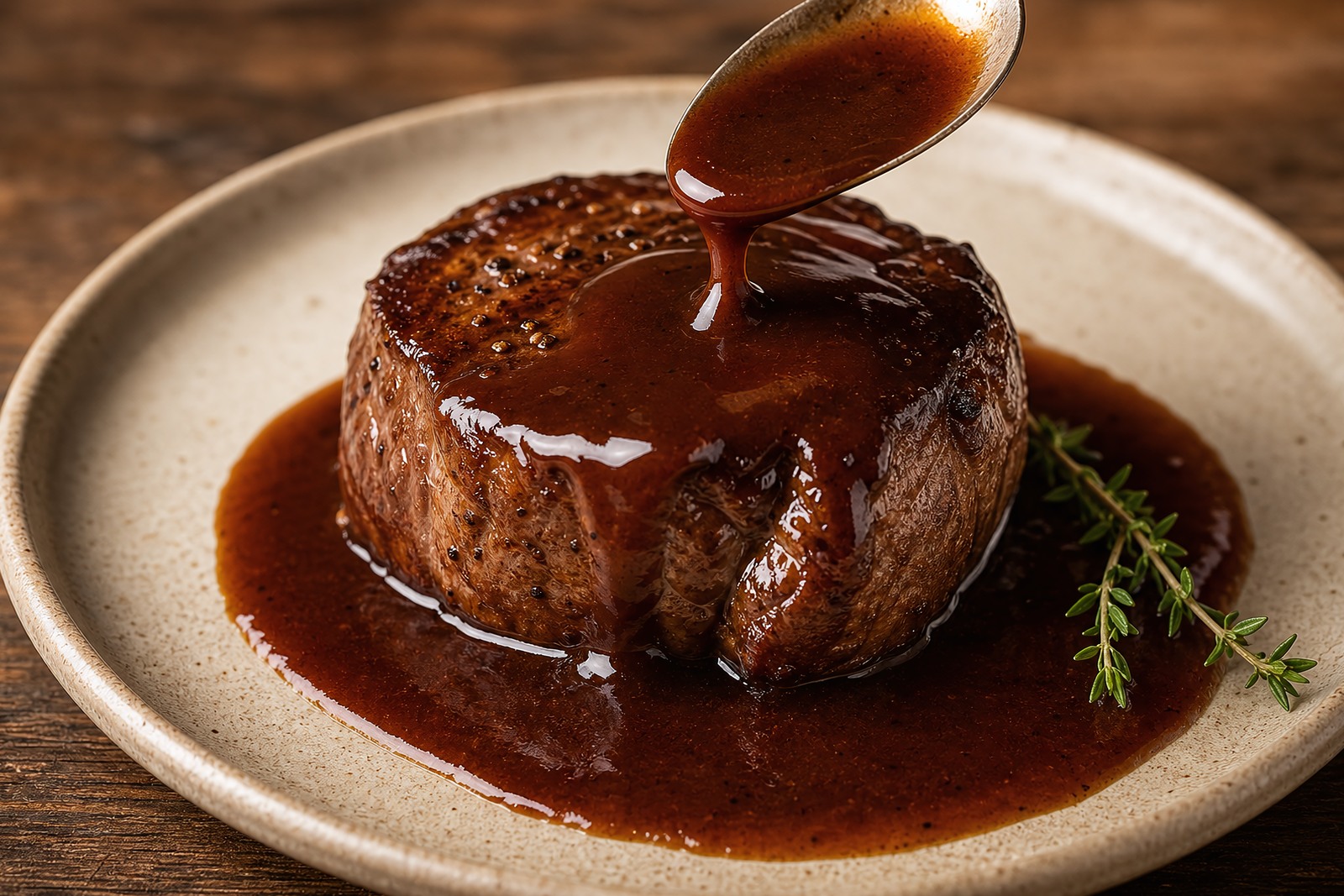
For a home cook, the honest move is to make a small batch on a Sunday and freeze it in 100 ml portions. From those portions you get bordelaise (demi-glace with red wine, shallot, and a slice of poached marrow) for a steak, sauce Robert (demi-glace with mustard and white wine) for pork, and chasseur (demi-glace with mushroom, tomato, and tarragon) for braised chicken. One afternoon buys you a month of weeknight sauces, in the same spirit as spending an afternoon on a complex mole and eating off it for weeks.
Tomate and hollandaise: the modern outliers
Sauce tomate sits apart because it is the only mother thickened largely by its own ingredient. Escoffier’s version simmers 1 kg of tomato with salt pork, a small roux, mirepoix, and stock for nearly two hours until it is glossy and concentrated. Its branches are gentler than you might expect: Provençale (with garlic, olive oil, and herbs) for grilled fish, Portugaise (with onion and reduced tomato) for eggs, and the lighter Napolitaine the French borrow back from Italy. If you are going to spoon any of these over pasta, it is worth remembering that the shape you reach for is not a neutral choice.
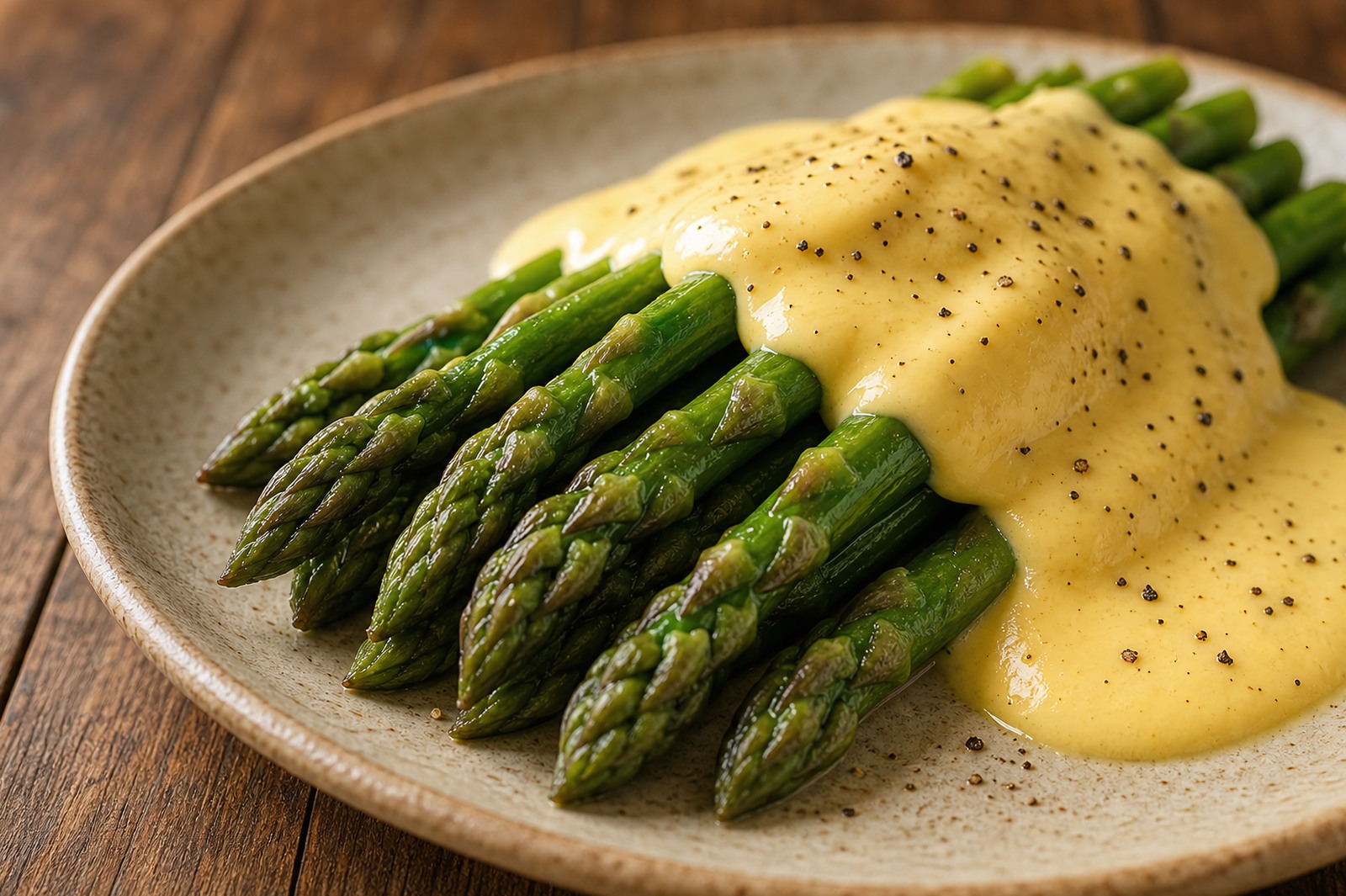
Hollandaise is the outlier because it carries no roux and no stock. It is an emulsion: three yolks whisked over a bain-marie with a tablespoon of reduced white-wine vinegar until ribbony, then 250 g of warm clarified butter trickled in while you keep whisking, finished with lemon and salt. Swap the vinegar reduction for a tarragon-shallot one and it becomes béarnaise, the sauce for a steak frites. Fold in whipped cream and it becomes mousseline, for asparagus. Replace the lemon with blood-orange juice and it becomes maltaise. The best seasonal window falls once in March and once in early April, when Sicilian blood oranges and the first French asparagus overlap for about three weeks.
The case for learning the framework
The argument in favour is efficiency. Escoffier’s brigade system was built on it: teach five bases, and a young cook can produce sixty sauces by the end of their first year. The same logic helps at home. Recipes begin to read as variations instead of isolated instructions. A “sauce chasseur” is no longer a mystery. It is espagnole with mushrooms.
The case against
The honest counter-argument comes from cooks like Michel Bras and the nouvelle cuisine generation, who argued from the 1970s onward that roux-based sauces were heavy, slow, and built for a different era. They favoured jus, emulsions of olive oil and herbs, and vegetable reductions. They were right about restaurant cooking. A two-Michelin-star plate today is more likely to carry a beurre monté and a herb oil than an espagnole.
But at home the calculus is different. You are not plating thirty covers. You are feeding four people on a Wednesday, and a small jar of frozen demi-glace turns a pan-seared steak into something your family remembers. The framework still earns its place at the home stove, even if it has retreated from the pass.
The pantry decision tree
At six in the evening, the contents of the fridge can make the decision.
- Milk and a piece of cheese, twenty minutes, a baking dish. Béchamel into Mornay, over cauliflower or pasta.
- Chicken stock, a chicken thigh, fifteen minutes. Velouté into suprême in the same pan.
- A piece of red meat, a glass of red wine, demi-glace in the freezer. Espagnole into bordelaise.
- A tin of San Marzano, an onion, an hour. Tomate into Provençale, over a grilled fish.
- Three eggs, a stick of butter, ten minutes, asparagus on the counter. Hollandaise, or maltaise if the blood oranges are still in season.
Five mothers, five weeknight dinners, and the same five techniques you will use for the rest of your life.
One last cue to keep beside the stove: when you make any roux-based sauce, whether béchamel, velouté, or espagnole, warm the liquid before you add it. Cold stock or cold milk hitting hot roux encourages lumps. Warm liquid blends into the roux more evenly and keeps the sauce smooth.