
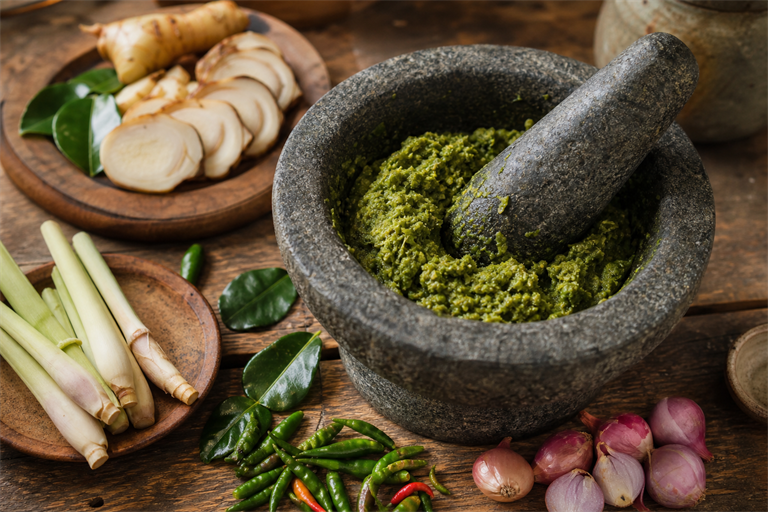

At Or Tor Kor market in Bangkok, just past six in the morning, the curry paste sellers are already at it. You hear the work before you see it: a flat, hollow thock bouncing off the concrete, slower and heavier than a knife on a board. Step closer and the smell arrives in one wave. Bruised lemongrass. Kaffir lime peel. Raw galangal. Shrimp paste roasting in the heat of friction alone. That sound, and that smell, is the recipe.
This is gaeng keow wan paste from central Thailand, built in a granite mortar called a krok hin. The thing most home cooks miss isn’t the ingredients (those you can track down), it’s the order and the patience. A blender shears the cells and throws the oils against hot metal. A mortar bruises and ruptures them slowly, so the aromatic oils come out cold and bind into something almost creamy. Different chemistry, different curry.
| Yield | About 200 g paste (enough for 2 curries, 4 servings each) |
| Prep time | 15 minutes |
| Cook time | 25–30 minutes of pounding |
| Total time | 45 minutes |
| Difficulty | Intermediate |
Why pounding beats blending
A blade cuts. A pestle crushes. When you pound galangal against granite, the cell walls rupture and release their oils into the fibres around them, where they stay suspended in the wet pulp. A blender, even a powerful one, shears those fibres and flings the volatile oils onto the walls of the jug, where they oxidise and evaporate off. Smell a freshly blended paste, then smell a pounded one fifteen minutes later. The pounded one is louder, deeper, and it stays that way in the pan.
There’s also the question of emulsion. A pounded paste fries differently. It splits cleanly into the coconut cream, releases its oil within two or three minutes, and carries the aroma straight up out of the wok. A blended paste tends to stew.
Tools and ingredients
You want a heavy granite mortar, at least 18 cm across the bowl and 4 kg or more. A light ceramic mortar will skitter across the counter and bruise your hand. The weight is the tool. To check a krok hin before buying, drop a coin into the empty bowl and listen for the ring: a low, dull tonk tells you the granite is dense all the way through. That’s the sound you want.
Ingredients (in pounding order)
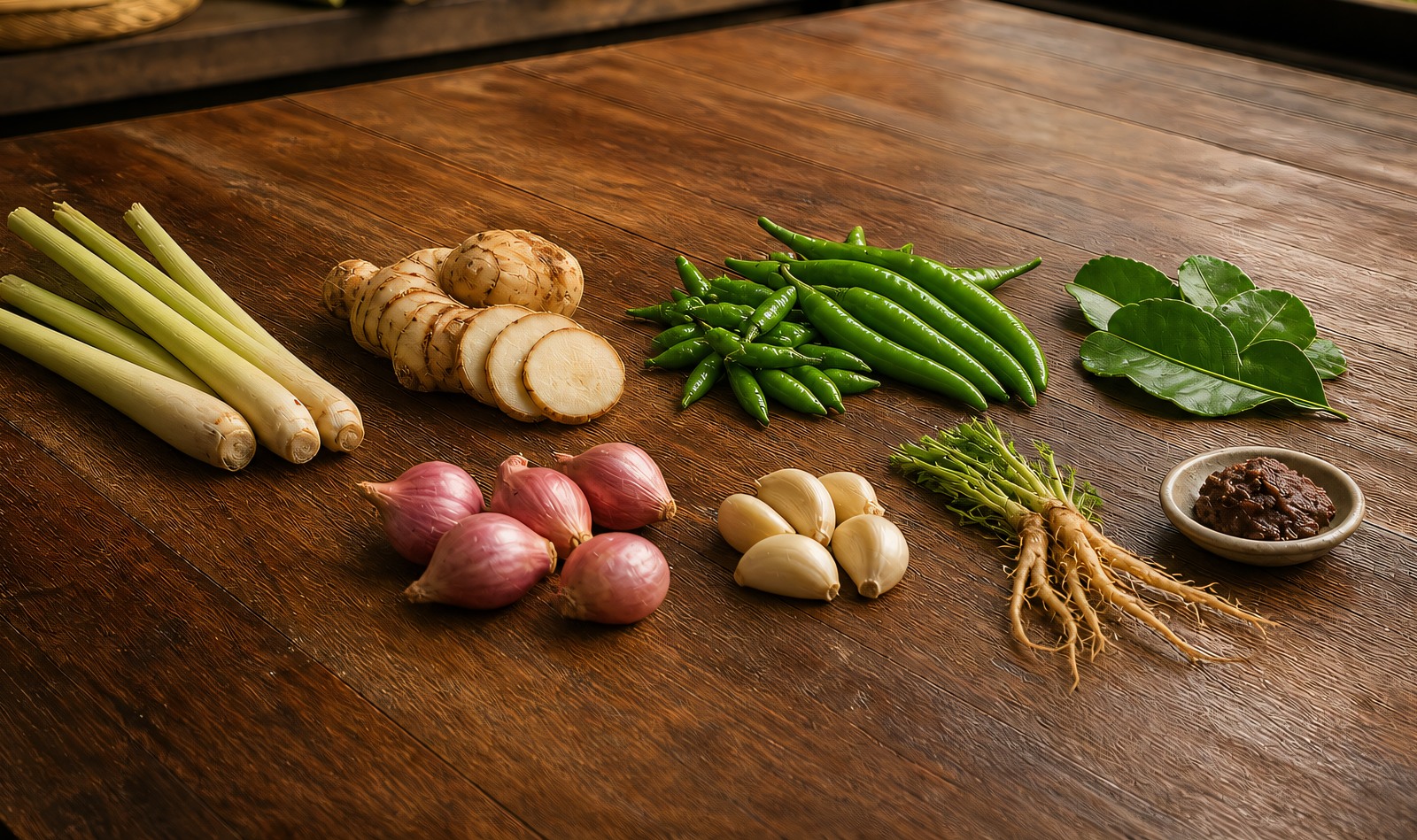
- 1 tsp coriander seeds, toasted
- 1 tsp cumin seeds, toasted
- 1 tsp white peppercorns
- 1 tsp fine salt (the abrasive, do not skip)
- 30 g galangal, peeled and sliced thinly across the grain
- 40 g lemongrass, only the pale lower 10 cm, sliced into thin rings
- Zest of 2 kaffir limes (or 6 kaffir lime leaves, centre rib removed, sliced into hair-thin ribbons)
- 25 g coriander root, scraped and chopped (or 30 g coriander stems)
- 25 large green bird’s eye chillies, stems removed, sliced
- 5 long green chillies, sliced (for body and colour, not heat)
- 60 g shallots, sliced thinly
- 40 g garlic, sliced thinly
- 1 heaped tsp kapi (Thai shrimp paste), wrapped in foil and toasted 2 minutes
Slice everything thinly before it goes near the mortar. A 2 mm round of lemongrass pounds in 90 seconds. A whole stalk will defeat you.
The pounding order, hardest to softest
This is the part no recipe card explains properly. You do not throw everything in at once. Each ingredient needs the previous one already broken down to act as its grinding bed.
-
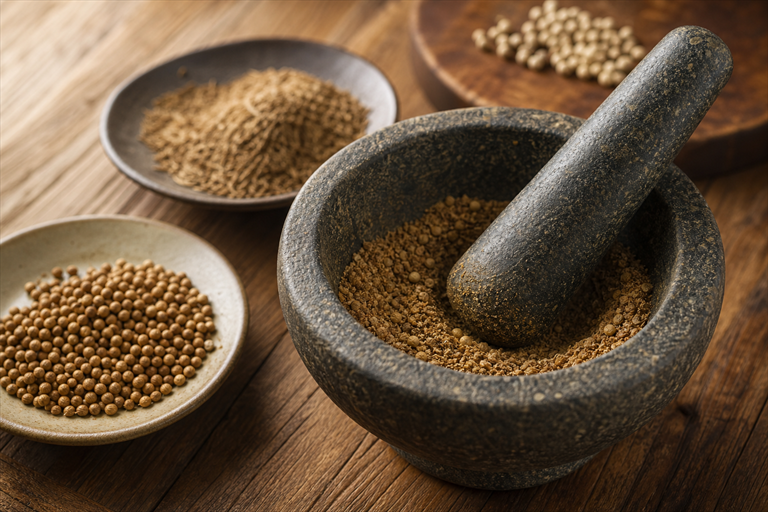
Pound the toasted coriander, cumin, peppercorns, and salt to a fine powder. Two minutes. The salt is your abrasive: it gives the pestle something to grind against and pulls moisture from whatever comes next. Tip the powder into a small bowl and set it aside.
-
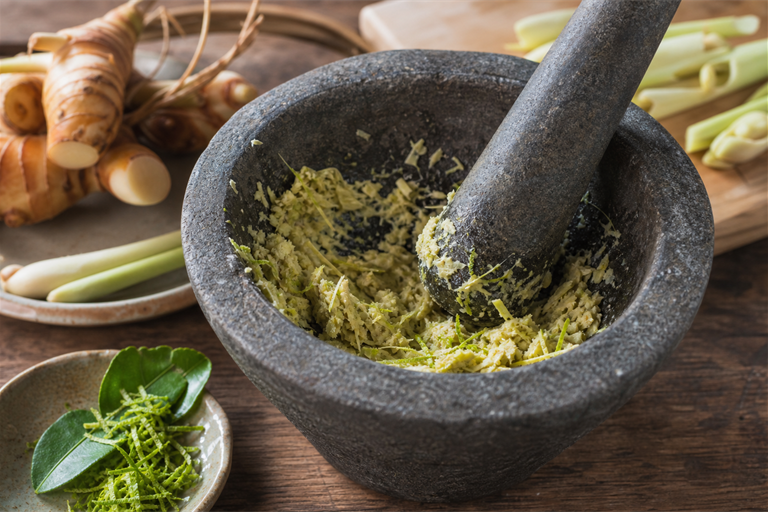
Add the galangal first. Pound steadily for 3–4 minutes, working in a circular motion against the wall of the mortar, until the fibres are completely broken down and the bottom of the bowl looks like wet sawdust. Galangal is the hardest aromatic in the recipe. If you add it later, it stays stringy forever.
-
Add the lemongrass. Pound for 3 minutes. You’ll hear the sound change from a sharp thock to a softer, wetter slap as the oils release. That sound is your cue. Then add the kaffir lime zest and pound 1 more minute until you cannot see individual specks of peel.
-
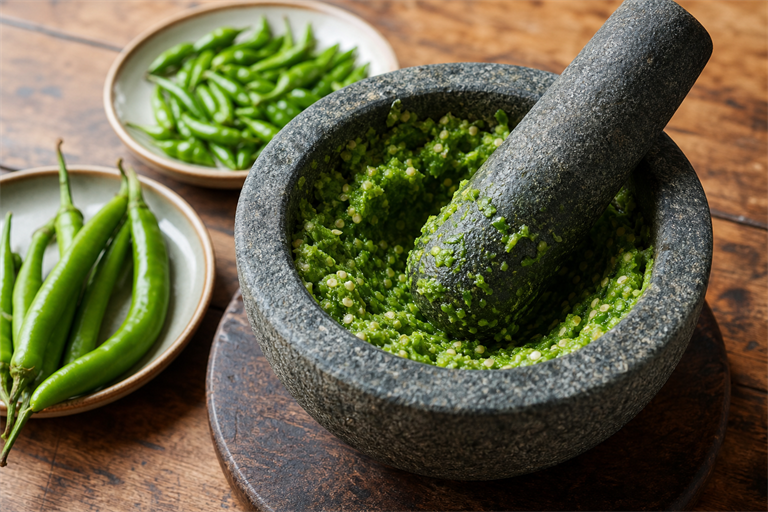
Add the coriander root. Pound for 2 minutes until it disappears into the mass. Then add both chillies, a handful at a time, pounding each addition for about a minute before adding the next. Total chilli pounding: 4–5 minutes. The paste should now be a coarse, vivid green slurry.
-
Add the shallots, then the garlic, pounding each for 2 minutes. These are wet and soft; they smooth the paste rather than thicken it. The mortar will get loud and splashy here. Slow down, lower your wrist angle, and pound closer to vertical to keep everything in the bowl.
-
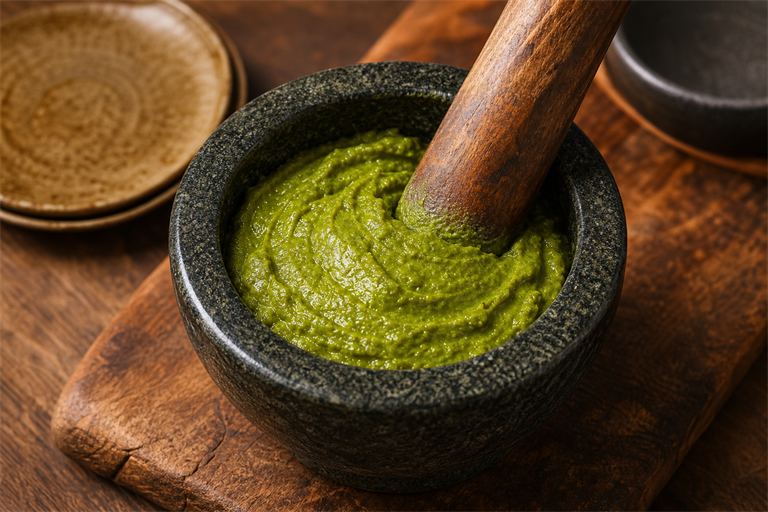
Add the reserved dry spice powder and the toasted kapi. Pound and stir for a final 3–4 minutes, scraping the sides down with a spoon every minute, until the paste is silky, glossy, and you can smear a teaspoon flat on the back of a spoon with no visible fibre. That’s the milestone. If it still looks grainy, keep going.
Rhythm, grip, and not destroying your wrist
Hold the pestle near the top, not the middle. Let its weight do the work; you are guiding, not swinging. Pound at about 90 strikes per minute, roughly the speed of a slow heartbeat. Every fourth or fifth strike, drag the pestle along the wall to fold the outer paste back into the centre. Your other hand cups the rim of the mortar to keep it steady and to catch splashes with your palm.
If your wrist starts aching, you’re gripping too tight or pounding too fast. Stop, shake the hand out, switch sides if you can. Thirty minutes is normal for a first paste. Experienced cooks at the market do it in twenty.
Storage and using it in gaeng keow wan
Use the fresh paste immediately or freeze promptly in small covered portions; thaw in the refrigerator when needed. Do not use an oil layer as a preservative for this garlic-and-herb paste. UGA Extension’s infused-oil guidance explains the hazard of storing nonacidified garlic and herbs in oil. This paste has no validated extended refrigerated shelf life. For a curry that feeds four, fry 60 g of paste in 80 ml of cracked coconut cream over medium heat for 3 minutes, until the oil splits out red-green at the edges. Then add the rest of a 400 ml tin of coconut milk, chicken or fish, Thai apple eggplants, fish sauce, palm sugar.
Taste at the end. You want salty first, then sweet just under it, then a slow heat that builds in the back of the throat, with lime and basil sitting bright on top. If it tastes flat, add more fish sauce, a teaspoon of Megachef or Squid brand at a time. If it bites without sweetness underneath, shave in a little more palm sugar until the heat rounds off. The paste tells you when it’s right. You only have to listen for it.