
Five in the morning at Or Tor Kor in Bangkok. The cement floor is still wet from the hose. A vendor pounds dried shrimp and palm sugar into som tam with a wooden pestle, lime juice hits the sugar in a clay mortar, and the air goes sharp then sweet in the same breath. That sharp-then-sweet is the whole region in one second. Thailand, Vietnam, Laos, Cambodia, Malaysia, Indonesia: six kitchens, one shared instinct. Hold sour, salty, sweet, and hot against each other until they push back equally.
Most Western cooking writes balance as harmony. Southeast Asian cooking writes balance as tension. The dish is not finished when the flavors agree. It is finished when each one is loud enough to argue with the others. A working tom yum, a Vietnamese nuoc cham, a Sumatran sambal: each one is held together by the same four-axis compass. Tune one axis up, and the others must rise to meet it. This piece walks the compass the way a cook learns it at home, by tasting, adjusting, and tasting again.
Four Pillars, Built Over Centuries
Fermented fish sauce is old. Roman garum dates to at least the 3rd century BCE, and the same fermentation logic moved east on trade routes. Khmer prahok and Lao padaek were already in daily use by the Angkor period (9th to 15th century). Bird’s eye chili (Capsicum frutescens) came from the Americas via Portuguese trade in the 16th century, reaching Malacca in the 1500s and spreading through the maritime trade routes within a generation. Before that, heat came from black pepper, long pepper (Piper longum), and galangal. Palm sugar from arenga and coconut palms has been tapped across the region for over a thousand years. Tamarind, originally African, naturalised across mainland Southeast Asia centuries before colonial contact.
These four ingredients did not arrive together as a system. Cooks assembled the system over generations, in response to a climate that ferments fast and grows fruit faster.
Sour Is Not Only Citrus
In Thailand, sour comes from lime, tamarind, and green mango. In Vietnam it is rice vinegar and tamarind. In the Philippines it is calamansi and the souring soups of sinigang, built on tamarind or kamias. In Lao and Isan kitchens, fermented padaek and pla ra carry their own sour edge along with deep funk.
A teaspoon of tamarind pulp behaves nothing like a teaspoon of lime juice. Tamarind brings sweetness behind the acid and stays in the mouth longer. Vinegar drops in clean and disappears. The fermented sours, padaek above all, sit underneath the dish like a second voice.
The Salt Behind the Salt
Fish sauce (nam pla in Thai, nuoc mam in Vietnamese, patis in Filipino) is the backbone. Good Thai nam pla runs around 25 to 30 grams of nitrogen per litre on the label, a rough proxy for amino acid load and umami weight. Red Boat 40N and Megachef are the names many home cooks reach for outside the region.
Shrimp paste (kapi, terasi, belacan, mam tom) is the same idea concentrated and fermented further. A pea-sized lump of belacan toasted dry and pounded into sambal gives a savoury hum that soy sauce cannot replicate.
Sugar That Carries More Than Sweetness
Palm sugar, not cane sugar. Coconut palm sugar in southern Thailand and Indonesia, arenga palm sugar (gula aren) in Java. The flavour is caramel, smoke, a trace of bitterness. Cane sugar is one-note next to it.
In Indonesian rendang, the dry caramelisation of palm sugar at the end of the long simmer carries half the flavour. In a Thai stir-fry the sugar hits the wok and Maillard-browns in seconds. The point is not sweetness on its own. It is the way the sugar rounds the corners of fish sauce and lime so they stop fighting.
Two Kinds of Heat
Bird’s eye chili (prik kee noo, ot hiem, cabai rawit) is small, fast, and sharp. The longer cayenne types (prik chee fa, cabai merah besar) bring colour and a slower heat. Capsaicin is fat-soluble, which is why coconut milk in a green curry softens the burn while water does nothing.
Layering matters. A pounded chili in the paste behaves differently from a sliced fresh chili dropped in at the end. The first gives heat throughout the dish. The second gives heat at the surface of the bite.
Four Dishes on One Compass
| Dish | Country | Sour | Salty | Sweet | Hot |
|---|---|---|---|---|---|
| Tom Yum Goong | Thailand | lime, kaffir lime leaf | fish sauce | small palm sugar | crushed bird’s eye |
| Nuoc Cham | Vietnam | lime, rice vinegar | fish sauce | white sugar | fresh chili, garlic |
| Sambal Terasi | Indonesia | lime or tamarind | belacan | gula aren | bird’s eye, long red |
| Som Tam | Thailand/Lao | lime, tamarind | fish sauce, dried shrimp | palm sugar | bird’s eye, pounded |
| Penang Assam Laksa | Malaysia | tamarind, asam gelugur | belacan, shrimp | small palm sugar | dried, fresh chili |
Tom yum is the textbook. Build a broth with lemongrass, galangal, kaffir lime leaf, and shrimp shells. Off the heat, add fish sauce, lime juice, palm sugar, and crushed bird’s eye. The lime goes last because heat dulls it within ninety seconds. Taste. If it stings the front of the tongue without depth behind it, add more fish sauce. If it tastes flat, more lime. If it reads only salty and sour, half a teaspoon more palm sugar bridges them. If the heat hides behind the sourness, pound the chili harder so the capsaicin spreads.
Nuoc cham is simpler and harder to nail. A Hanoi ratio runs 1 part fish sauce, 1 part lime, 1 part sugar, 4 parts warm water. Garlic and fresh chili go in at the end. The water is the secret. It lengthens the sauce so all four axes sit equal on the palate when you dip a piece of cha gio. Skip the water and the sauce becomes a paste that drowns the food.
Sambal terasi from Java is built differently. Toast the belacan dry in a small pan until it cracks. Pound it with bird’s eye, long red chili, garlic, shallot, gula aren, and a squeeze of lime. Fry the paste in coconut oil until it darkens and the oil rises at the edges. The sugar caramelises against the shrimp paste, the chili sinks into the fat. Tasted alone the sambal should feel almost too much. Spread on rice next to grilled fish, it disappears into balance.
Where the Compass Helps, and Where It Misleads
The compass is how cooks across the region actually talk. David Thompson, in Thai Food (2002), describes the same four directions in different words. James Oseland, in Cradle of Flavor (2006), uses the same instrument to read Indonesian and Malay rempah. Once a home cook learns to taste in four axes, a Lao laap and a Penang assam laksa become legible from the same panel. The compass also gives a diagnostic tool. When a dish feels off, asking which axis is too quiet is faster than rereading the recipe.
The honest critique is that four axes flatten the region. Lao laap and many Isan dishes carry a bitter axis (raw bile, bitter herbs) the model ignores. Filipino adobo leans on sour and salty almost without sweet or hot. Burmese cooking uses fermented tea leaves and dried shrimp in a register the four-axis frame barely registers. A cook who only thinks in four axes will miss the bitter and the funky, which carry as much weight in some kitchens as sweet does in others.
So treat the compass as a starting frame, not a finished map. Use it to learn the basics. Then add bitter, funky, and aromatic as fifth, sixth, and seventh dimensions when the dish calls for them.
Building Balance on Your Own Counter
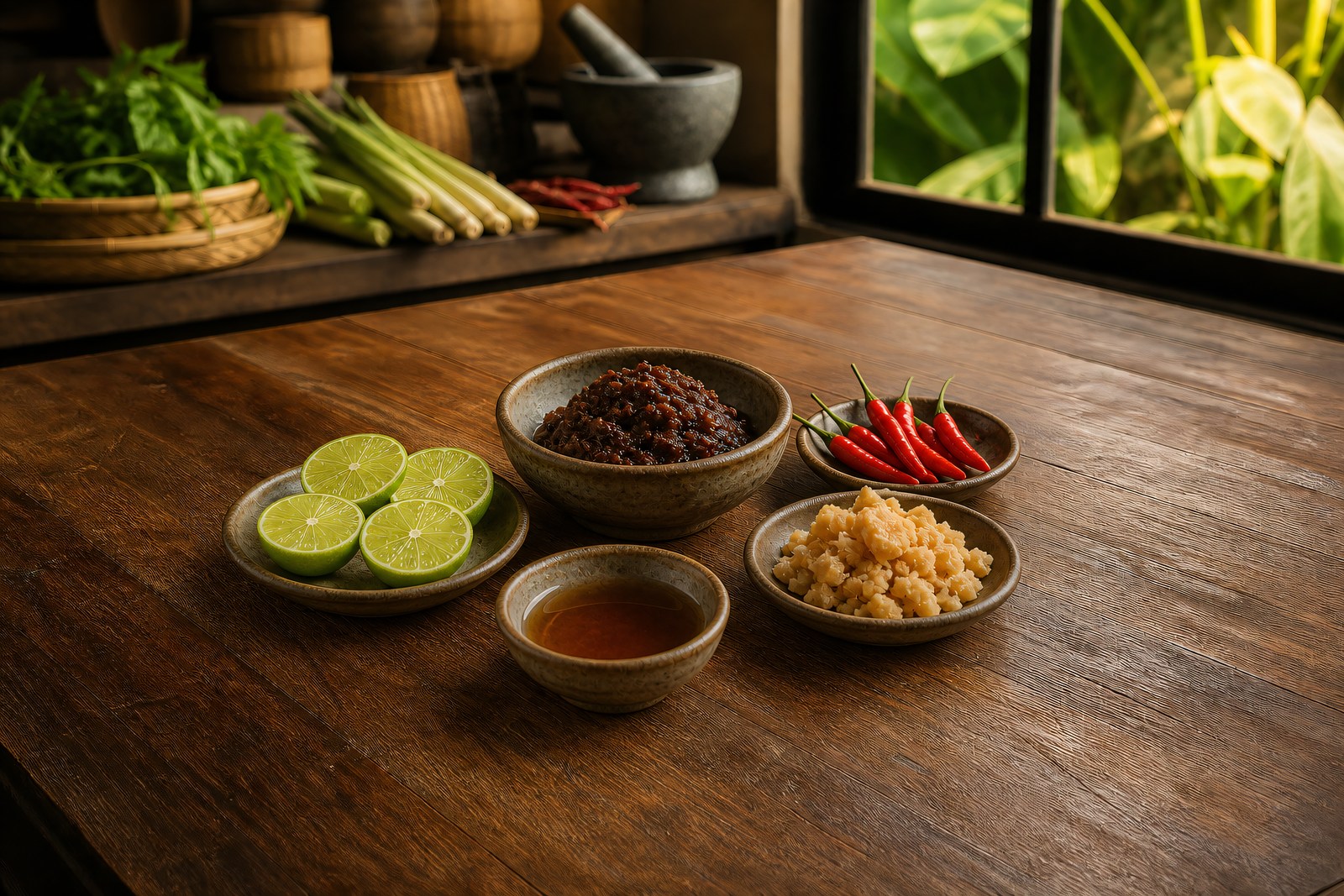
Keep five things within reach. Good fish sauce. Palm sugar in a block, shaved with a knife. Whole limes, halved only at the moment of use. A small jar of toasted belacan or mam tom in the fridge. Fresh bird’s eye chili.
Cook the dish to the recipe. Before serving, taste from a spoon and ask in this order. Is it salty enough to wake the tongue? Is it sour enough to cut the fat? Is the sweetness rounding the corners without taking over? Does the heat sit behind or in front of the flavour? Adjust one axis at a time, never two. Wait ten seconds between tastes. The tongue resets.
If a Thai dish tastes only sour and salty, the palm sugar is shy. Shave more from the block, melt it into a spoon of hot stock, stir it back in. If a Vietnamese dipping sauce tastes muddy, the water is short. If a sambal tastes raw, the belacan is undertoasted. Adjust the fish sauce only after the sugar, and adjust the lime last of all. The dish is done when each of the four pushes back, and none of them wins.