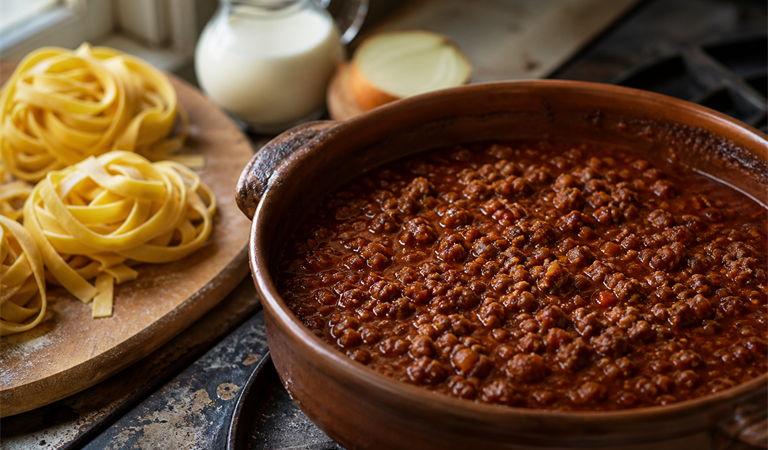
Last Sunday I cooked the ragù I grew up eating in Bologna, in a 28cm enamelled cast iron pot on a modest four-burner gas stove. 300g coarsely ground beef chuck, 150g coarse pork shoulder, 150g pancetta tesa from the deli, 80g each of carrot, celery and onion, 120ml dry white Trebbiano, 200ml whole milk, 2 tablespoons of double-concentrate tomato paste, 300ml light beef broth. Three hours and twenty minutes at the lowest flame my stove will hold. The sauce comes out the colour of dark caramel, glossy, barely wet, and it is nothing like what most of the world calls “spaghetti bolognese.”
That dish does not exist in Bologna. Not in restaurants, not in homes, not on any nonna’s table. The recipe I’m giving you is the one the Accademia Italiana della Cucina registered with the Bologna Chamber of Commerce in 1982, the official version, with the small adjustments every Bolognese family makes. Once you cook it this way, the tomato-heavy version will taste loud and thin to you. That is the point.
What This Sauce Actually Is
Ragù alla Bolognese is a meat sauce in which tomato is a seasoning, not a base. The body is meat slowly broken down in its own fat and a little broth, rounded with whole milk, and bound by a soffritto so finely cut it almost dissolves. It is dark brown, not red. It clings. It does not pool. A spoonful on a plate should hold its shape for a moment before relaxing.
The Italian-American red sauce with ground beef is a different and perfectly good dish, but it is not this. Calling it Bolognese in Bologna will get you a tired smile — the same tired smile a Bangkok cook gives when a tourist orders what they think is authentic pad kra pao and expects sweet basil and a pile of vegetables.
The Ingredients, And Why These Exact Ones
The 1982 ratio is built for one kilo of mixed meat. I scale it down for a family of four. Here is what goes in my pot, and what each ingredient is doing.
| Ingredient | My amount | Role |
|---|---|---|
| Coarse-ground beef chuck | 300 g | Body, collagen for gloss |
| Coarse-ground pork shoulder | 150 g | Sweetness, fat |
| Pancetta tesa, finely diced | 150 g | Cured depth, rendered fat |
| Carrot, celery, onion (1:1:1) | 80 g each | Soffritto sweetness |
| Double-concentrate tomato paste | 2 tbsp (about 35 g) | Colour and a thread of acidity |
| Dry white wine (Trebbiano, Pignoletto) | 120 ml | Deglaze, lift the fond |
| Whole milk | 200 ml | Tenderises the meat, rounds the acid |
| Light beef broth | 300 ml, added in stages | Long-cook moisture |
| Salt, black pepper, a pinch of nutmeg | to taste | Seasoning |
A note on the meats. Use coarse grind, not the fine supermarket mince. Fine grind turns to paste. If you can only find fine, pulse some chuck and shoulder in a food processor for three or four pulses. White wine, not red: red overpowers the milk. And yes, milk. It is the single ingredient most home cooks skip, and the one that does the most work.
Building The Sauce, Step By Step
Render the pancetta first, 8–10 minutes on medium-low. Use a wide heavy pot, no extra oil. You want a thin film of pork fat in the bottom and the pancetta turning pale gold. That fat is your cooking medium. Skip it and the soffritto fries in olive oil, which is Tuscan, not Bolognese.
Now the soffritto, 12–15 minutes on low. Add the carrot, celery and onion, all cut to a 3mm dice or smaller. Stir often. You are not browning, you are sweating until the onion goes translucent and the carrot loses its raw edge. The vegetables should almost melt. Rushing this step is the single most common home mistake.
Brown the meat in two batches, 6–8 minutes each. Raise the heat to medium-high. Push the soffritto to the sides, add half the beef and pork, leave it untouched for two minutes to catch colour, then break it apart. Brown means brown: actual Maillard, not grey. Season lightly with salt as it cooks.
Deglaze with the wine, 3–4 minutes. Pour in the 120ml of Trebbiano, scrape the brown bits off the bottom with a wooden spoon. Let it bubble until you cannot smell raw alcohol; the surface should look almost dry again.
Add the tomato paste and 150ml of broth. Stir the paste in until it darkens by a shade, about 90 seconds. Then the broth. Bring it to a bare simmer, the lowest steady bubble your burner will give you. If your stove runs hot, use a flame tamer or shift the pot half off the burner.
Cook low for two hours with the lid cracked open. Stir every 20 minutes. Top up with broth, 50ml at a time, whenever the surface looks dry. The sauce should always be slightly wetter than you want it to finish. It will tighten at the end.
Add the whole milk, then cook one more hour. Pour the 200ml of milk in slowly, stir, return to that same whisper of a simmer. The milk will look curdled for the first ten minutes. Ignore it. It smooths out as the proteins relax into the sauce. This step is what makes the meat tender instead of grainy.
Final check, last 15 minutes. Taste. Adjust salt. Grate in a small pinch of nutmeg, maybe a quarter teaspoon. Crack black pepper. The sauce should coat the back of a spoon and leave a clean line when you drag a finger through it. If it is still loose, simmer uncovered five more minutes. If it tightened too far, loosen with a splash of broth.
If your ragù tastes flat at the end, it is almost always undersalted or undercooked, not under-tomatoed. Resist the urge to add more paste.
Why Tagliatelle, Never Spaghetti
Spaghetti is round and smooth. Ragù is heavy and chunky. The sauce slides off and pools at the bottom of the bowl, which is exactly what you see in the international “spag bol.” Tagliatelle is flat, porous, about 8mm wide in Bologna, and made with egg. The rough surface grips the meat, the width carries it, the egg richness matches the milk and fat in the sauce. This is physics, not snobbery.
Cook 80–90g of fresh tagliatelle per person in well-salted water, 2–3 minutes until just tender. Drain, keeping a ladle of pasta water. Toss the pasta in the pot with the ragù over low heat for 30 seconds, loosening with a splash of pasta water until each strand is coated. Plate. Grate Parmigiano-Reggiano over the top at the table (24-month, not pre-grated).
In Bologna no one would ever serve this sauce on spaghetti, finish it with garlic, or add cream at the table. The milk went in two hours ago, and it has been doing its work the whole time.