
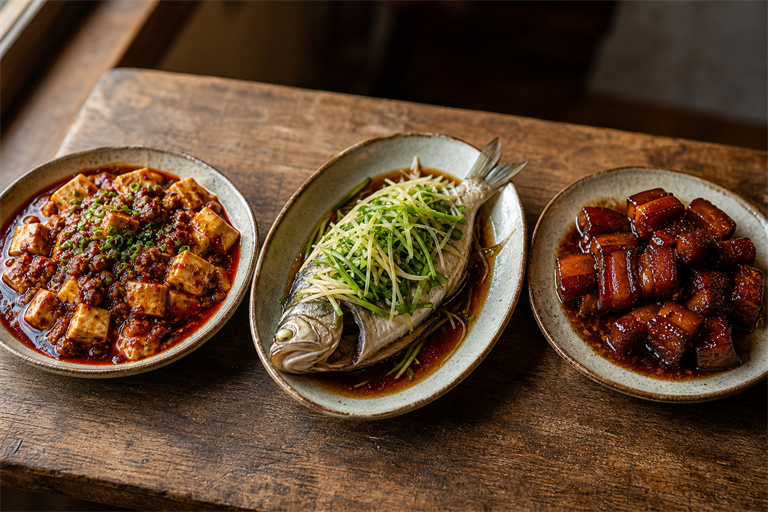
There is a stretch of road in Chengdu, near the river, where three kitchens face each other across two lanes of traffic. One pours chili oil over cold rabbit at ten in the morning. Another sends up the steam of a whole bass with ginger and scallion, the lid lifted for ten seconds and clapped back down. The third, run by a Hunan family who moved south, hangs strips of pork belly over smoldering tea leaves and orange peel. Stand on the curb and the air carries all three at once. That stretch of road is a clean answer to the question home cooks keep asking: which regional kitchen is actually on the stove when a dish gets called “Chinese”?
This piece is for the home cook standing in front of a wok with soy sauce, chili paste, and a piece of fish, trying to decide which tradition the next forty minutes belong to.
Why these three, and not the other five
China is usually mapped into eight regional cuisines, but Sichuan (Chuan), Cantonese (Yue), and Hunan (Xiang) are the three that get tangled together in English-speaking kitchens. They share plenty: rice as the staple, the wok as the central pan, soy and ginger humming in the background. But they answer four questions very differently. How should heat feel. What fat carries the dish. What technique sets the texture. What sits in the pantry as the non-negotiable.
Get those four right and you can tell, mid-bite, which region a dish belongs to.
The four axes, side by side
| Axis | Sichuan (Chuan) | Hunan (Xiang) | Cantonese (Yue) |
|---|---|---|---|
| Heat philosophy | Ma-la, numbing-hot from Sichuan peppercorn plus dried chili | Gan-la, dry, bright, fresh chili burn without numbing | Xian, clean savoriness, chili rare and incidental |
| Signature fat | Rendered chili oil, lard, rapeseed oil | Lard, smoked pork fat, rendered duck | Peanut oil, light vegetable oils, a thin slick at most |
| Core aromatics | Sichuan peppercorn, doubanjiang (chili-bean paste), ginger, garlic, dried chili | Salted chopped chili (duo jiao), smoked chili, fermented black bean, garlic, ginger | Ginger, scallion, Shaoxing wine, garlic, white pepper |
| Signature techniques | Stir-fry layering, gan bian (dry-frying), hui guo (twice-cooked) | Steaming with duo jiao, smoking, slow red-braising | High-flame stir-fry for wok hei, blanching, long steaming |
| Pantry non-negotiable | Pixian doubanjiang, whole red Sichuan peppercorn | Jarred duo jiao, smoked bacon (la rou) | Light soy, dark soy, oyster sauce, Shaoxing |
| Salt level (home cook) | High, balanced against numbing | Medium-high, balanced against acid | Low to medium, balanced against freshness |
| Default rice | Long-grain white | Long-grain white | Long-grain white, sometimes jasmine |
| Wok temperature | Very high, then dropped for layering | High, often paired with steamer | Highest. Wok hei lives at 230C+ surface |
Heat: ma-la, gan-la, xian
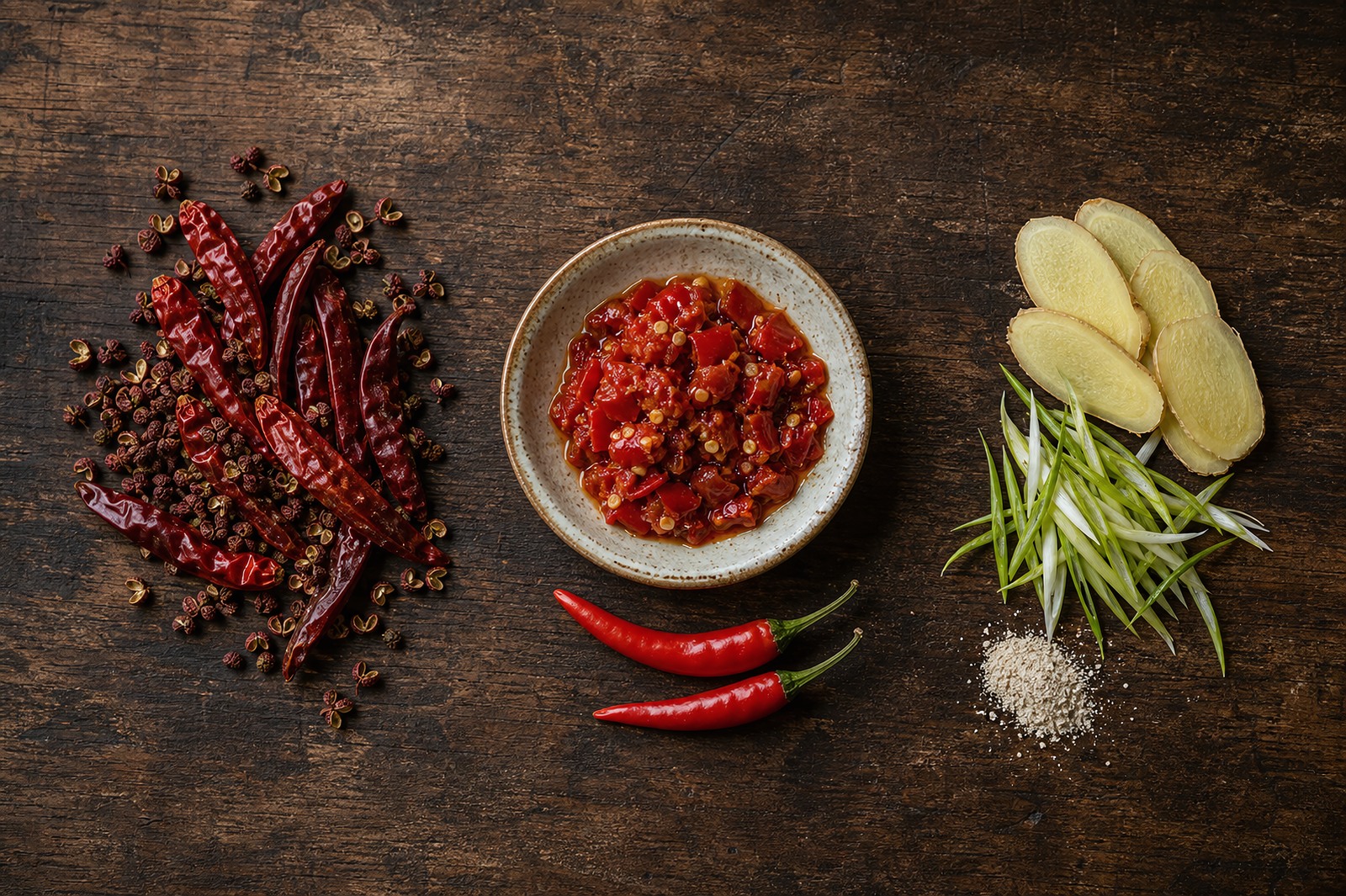
Sichuan heat is a sensation as much as a flavor. The Sichuan peppercorn (hua jiao) does the numbing. Dried chili does the burning. Together they make ma-la, and a proper mapo tofu hits both within fifteen seconds of the first bite. Your lips buzz before your tongue catches the chili.
Hunan does not numb. There is no Sichuan peppercorn in a Hunan kitchen, or barely any. The heat is gan-la, dry heat, and it comes from fresh red chilies, salted chopped chilies (duo jiao, packed in jars), and smoked chilies hung over the stove. The burn is sharper and arrives faster. The dish feels drier on the palate, less oiled, often more sour.
Cantonese cooking, by contrast, is built around xian, the clean savoriness of fresh seafood, good stock, and restrained seasoning. A Cantonese cook reaches for chili last, if at all. The dish should taste of the thing itself. A steamed fish from Guangzhou is judged on the fish, not the sauce.
Fat and pantry: what the spoon hits first
Open a Sichuan home cook’s pantry and you find Pixian doubanjiang in a brown jar, whole red Sichuan peppercorns in a paper bag, dried er jing tiao chilies, and a tub of chili oil they made themselves. The fat is rendered, often red, and clings to the food.
A Hunan pantry has different jars. Duo jiao, the chopped salted red chili, sits on the counter. It goes on steamed fish heads, on eggs, on tofu. Smoked pork (la rou) and smoked chilies hang from a beam or a hook above the stove. Fermented black beans appear constantly. The fat is often rendered from that smoked pork, carrying the flavor into everything it touches.
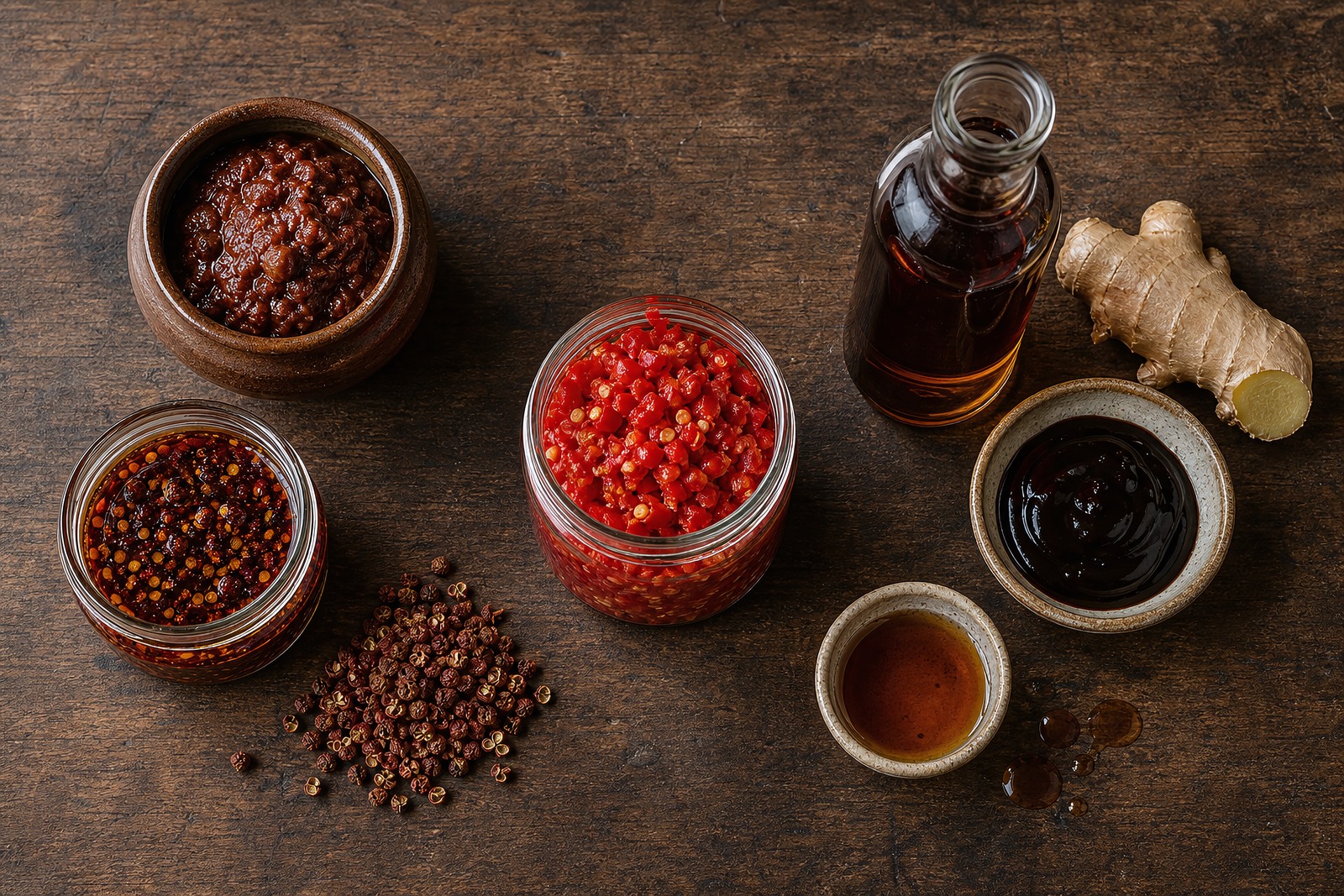
A Cantonese pantry is sparser. Light soy, dark soy, oyster sauce, Shaoxing wine, white pepper, ginger, scallion, sesame oil. Peanut oil for the wok. The pantry is restrained because the technique does the work.
Three benchmark dishes
The fastest way to feel the difference is to cook one signature dish from each region in the same week.
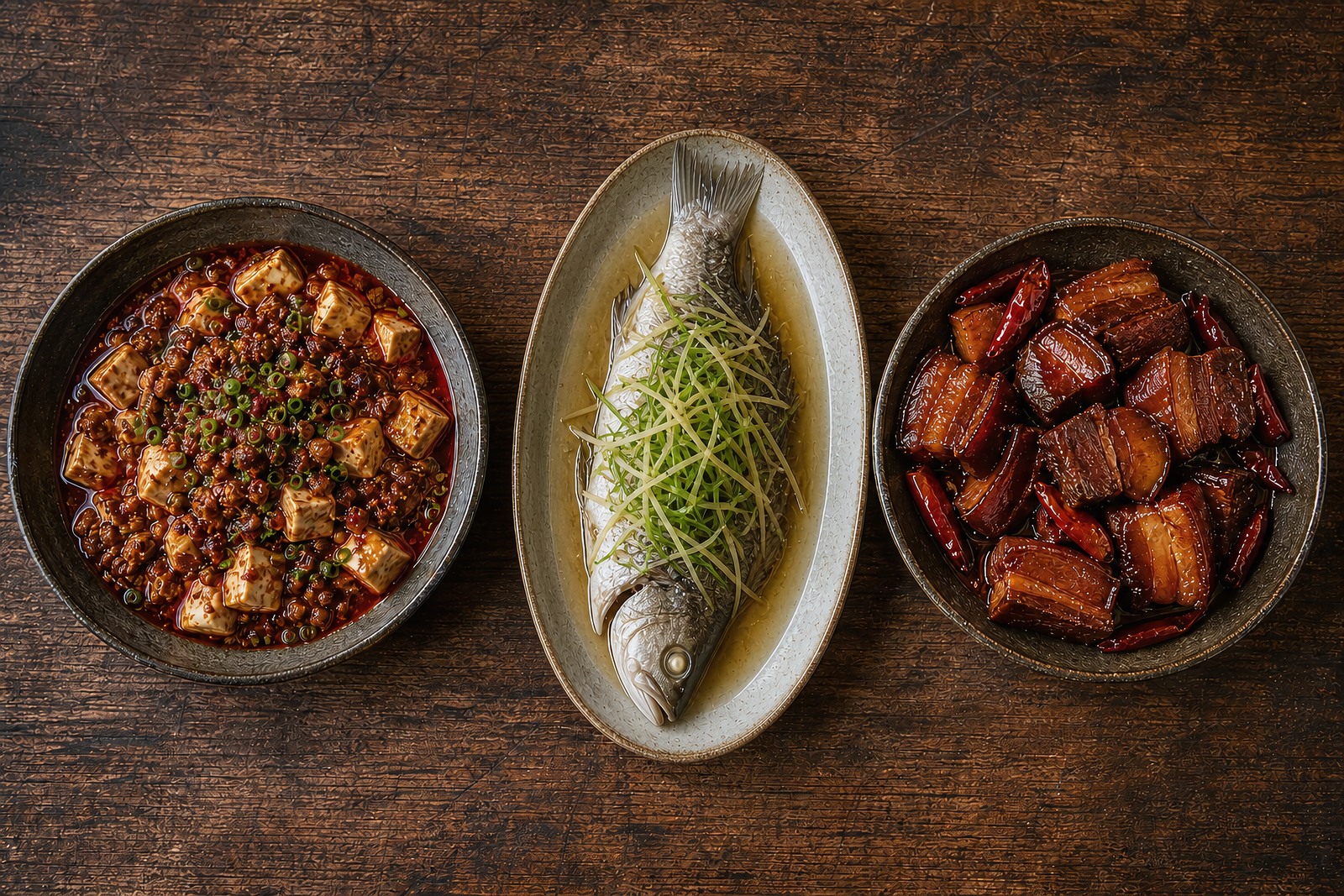
Mapo tofu (Sichuan). 400g silken tofu, cubed and held in 70C salted water for 3 minutes. Brown 100g ground beef in 30ml rapeseed oil, push to one side, fry 2 tablespoons Pixian doubanjiang for 60 seconds until the oil turns red. Add 1 teaspoon ground roasted Sichuan peppercorn, garlic, 200ml stock, the drained tofu. Simmer 4 minutes. Finish with another pinch of fresh-ground peppercorn off the heat. The dish is red, glossy, numbing.
Cantonese steamed fish. A whole sea bass, 600g, scored twice on each side, set on a plate with ginger slivers. Steam over rolling water for exactly 8 minutes for a fish of that size. Pour off the liquid that pools on the plate. Top with fresh scallion and cilantro. Heat 30ml peanut oil to smoking, pour over the herbs so they hiss. Drizzle 2 tablespoons of a 1:1 light soy and steaming-fish soy mix. Nothing else. The fish should taste of fish.
Chairman Mao’s red-braised pork (Hunan). 700g skin-on pork belly, blanched 3 minutes, cut into 3cm cubes. Caramelize 40g rock sugar in 20ml oil until amber, add the pork, color it on all sides over 5 minutes. Add 4 dried red chilies, ginger, star anise, 30ml dark soy, 60ml Shaoxing, water to nearly cover. Simmer covered 60 minutes, uncover and reduce 20 minutes until the sauce coats the back of a spoon. No Sichuan peppercorn. No doubanjiang. The heat is dry, the sugar is dark, the pork is glossy.
How to choose tonight
- You want your mouth to buzz and tingle for an hour after dinner: Sichuan. Start with mapo tofu or fish-fragrant eggplant.
- You want sharp, dry heat with smoke behind it and you have salted chilies or smoked bacon in the fridge: Hunan. Steamed fish head with duo jiao, or a stir-fry of la rou with leeks.
- You have a piece of very fresh fish, scallops, or a whole bird, and you don’t want to mask it: Cantonese. Steam, blanch, or a clean stir-fry with ginger and Shaoxing.
- You are cooking for someone who finds chili oil too oily but loves heat: Hunan, not Sichuan.
- You have 25 minutes and a hot wok: Cantonese stir-fry with wok hei, or a fast Sichuan dry-fry.
- You have 90 minutes and a heavy pot: Hunan red-braise.
One last thing about timing, because this is where home cooks lose all three cuisines. Sichuan peppercorn loses its aroma if you fry it longer than 20 seconds; toast it in a dry pan first, then grind, then add at the very end. A Cantonese steamed fish is overcooked at 9 minutes for a 600g fish, so pull it at 8 and let residual heat finish it on the plate. The duo jiao on a a Hunan steamed dish goes on raw, on top, before the steam, never stirred into the sauce. Three regions, three different clocks, and the cook who reads them right is the cook whose food tastes like it came from that road in Chengdu, not from a generic takeout menu.