
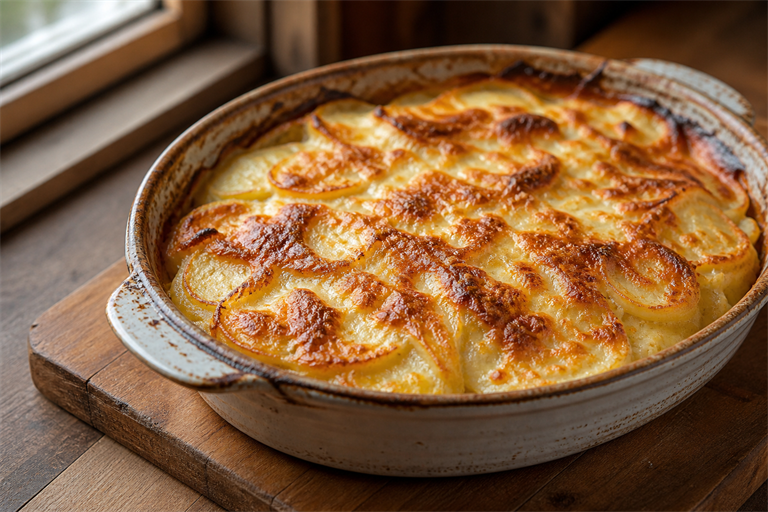

Warm cream and nutmeg scent a quiet kitchen while oven heat fogs the windows and a copper saucepan catches the light beside a mandoline. Gratin dauphinois suits that slow January rhythm: measured slices, gentle heat, no hurry.
For this version, layer 1.2 kg of Charlotte potatoes in a ceramic dish and bake at 150°C for one hour and forty minutes. The low oven gives the raw starch time to bind the cream while the top deepens to gold.
The dish comes from Dauphiné, the country around Grenoble. Not Savoie. The proper version has no cheese, no béchamel, and no pre-boiled potatoes. The cream sets because the raw starch from unrinsed slices binds it as it bakes. That single fact is the whole recipe.
| Dauphinois | Savoyard | |
|---|---|---|
| Cheese | none | Beaufort or Gruyère |
| Liquid | milk + cream | broth + cream |
| Origin | Dauphiné | Savoie |
| Yield | 6 servings |
| Prep time | 25 minutes |
| Cook time | 1 hour 45 minutes |
| Total time | 2 hours 30 minutes (with rest) |
| Difficulty | Intermediate |
Ingredients
- 1.2 kg waxy potatoes (Charlotte, Yukon Gold, or Belle de Fontenay)
- 1 large garlic clove, peeled
- 400 ml whole milk
- 400 ml heavy cream (35% fat)
- 1 tsp fine sea salt, plus more for layering
- Freshly ground black pepper
- 1/4 tsp freshly grated nutmeg
- 15 g cold unsalted butter, for the dish
Equipment
- A mandoline, or a very sharp chef’s knife and a steady hand
- Shallow gratin dish, ceramic or enamel, about 25 × 20 cm
- Small saucepan
- A thin knife or skewer to test for doneness
The method, step by step
-
Heat the oven to 150°C (300°F) on the middle rack. Rub the inside of the gratin dish hard with the peeled garlic clove, pressing until the clove smears across the surface. Then butter the dish lightly. The garlic perfume rises through every layer from the hot ceramic.
-
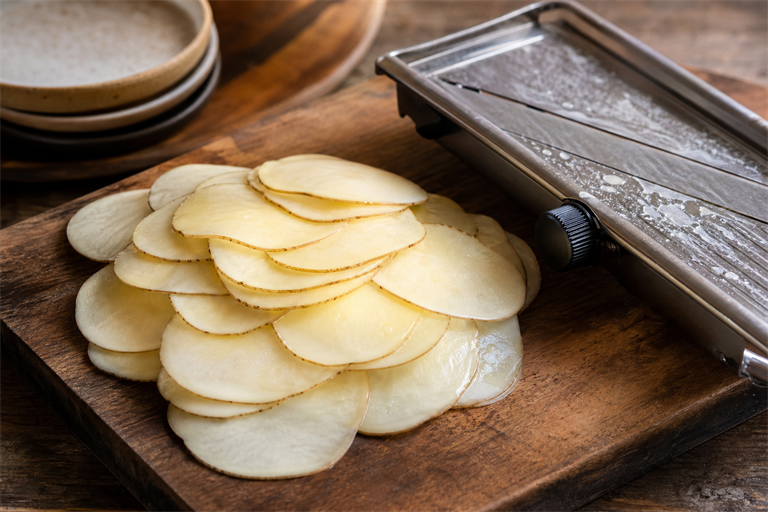
Slice the potatoes 2 to 3 mm thick on the mandoline. Do NOT rinse them. The cloudy starch on the slices is the binder for the entire dish. As they bake, the slices release amylose into the cream and thicken it into a silky set. Rinse them and you get a watery, broken gratin instead.
-
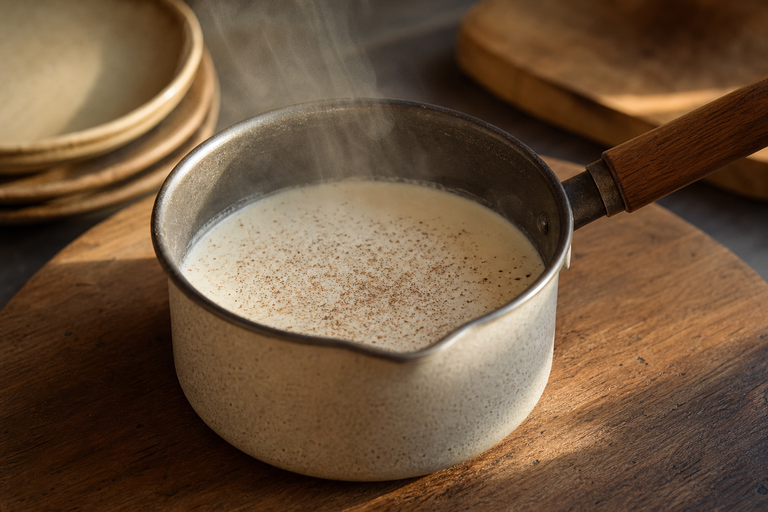
Warm the milk, cream, salt, several grinds of pepper, and the nutmeg in the saucepan over low heat. Bring it to roughly 70°C (160°F). The cream should steam but never simmer. Hot cream poured over the potatoes lets them start cooking the moment they meet the oven.
-
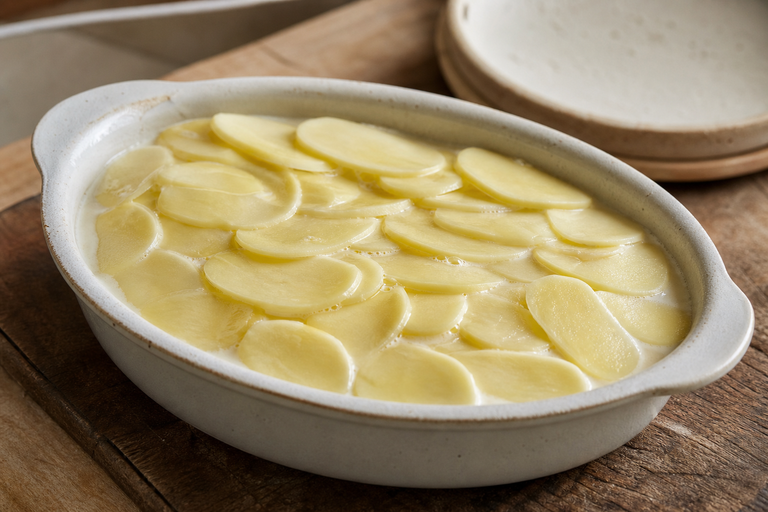
Layer the potato slices in the dish, overlapping like roof tiles. Three or four layers is right. Season each layer with a small pinch of salt and a turn of pepper. Even seasoning matters: skip a layer and you taste the dish unevenly.
-
Pour the warm cream over the potatoes until it reaches just below the top layer. Do not submerge the surface. If the cream covers the top, you boil the slices instead of letting them brown.
-
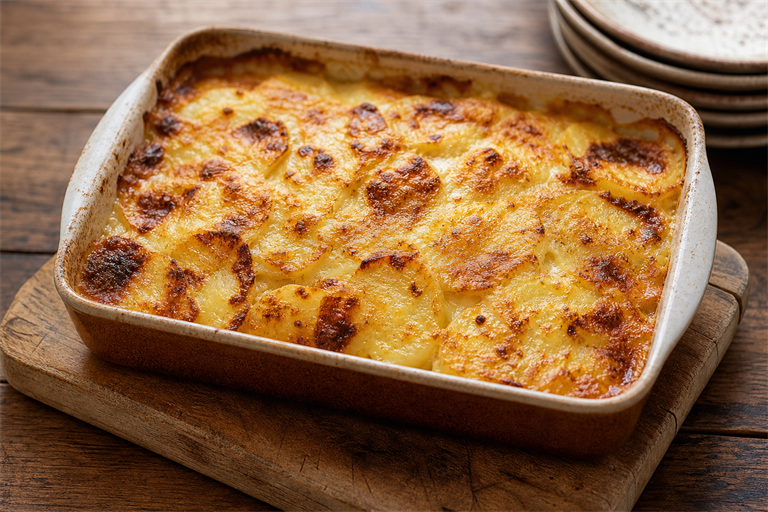
Bake for 1 hour 30 minutes to 1 hour 45 minutes. The gratin is done when a thin knife slides through the center without resistance. The top should be deep golden and the cream set, not sloshing in the dish when you nudge it.
-
Rest the gratin on the counter for 15 to 20 minutes before serving. The starch finishes setting as it cools. Slice it too soon and the layers slide apart on the plate.
Where it tends to go wrong
Variety matters. Charlotte, Yukon Gold, and Belle de Fontenay are waxy enough to hold their shape but starchy enough to bind. Russets fall apart and turn mealy. This kind of ingredient-first thinking matters across cuisines — the same principle drives a properly built Japanese weeknight meal around ichiju sansai, where the rice variety alone changes the whole table.
Curdled cream means the oven is too hot. Stay between 150 and 160°C (300 to 325°F). High heat splits the dairy.
A watery bottom means you rinsed the slices or reached for a low-fat cream. Use 35% fat heavy cream and skip the rinse. An undercooked centre means the slices were too thick. Stay at 2 to 3 mm. Above that, the dish needs another 30 minutes of baking that ruins the top.
A pale top after the full bake? Slide it under the broiler for 2 to 3 minutes. Watch it the whole time.
Leftovers reheat at 150°C (300°F) for 20 minutes, covered.
At the table
In Dauphiné, gratin dauphinois sits beside a slow-roasted leg of lamb or a simple roast chicken. A green salad with a sharp Dijon vinaigrette cuts the cream. A bottle of Crozes-Hermitage or a young Côtes du Rhône feels exactly right next to it.
If you like this kind of patient, technique-led cooking, the same steady attention turns up in rolling tagliatelle by hand the Bolognese way and in the slow reduction behind Padang-style beef rendang — dishes where one technique, done properly, is the whole recipe.
One last thing before the dish goes into the oven: warm the cream first. Cold cream sets the starch unevenly, and the difference shows in every bite.