
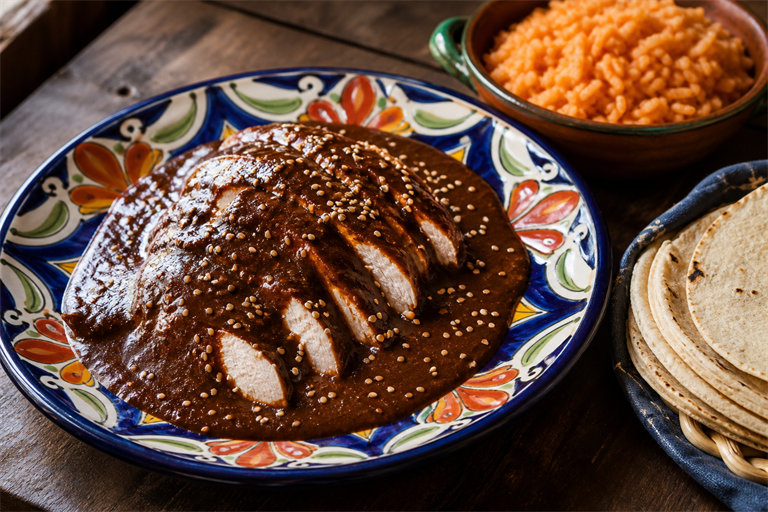

Mole poblano can eat an afternoon fast. Eleven-hour attempts, three burned anchos, a dark pot that smells of ash by morning: most first tries stumble in the same places. The recipe is not a marathon, and length is not the problem.
Mole poblano is not a long recipe. It is a careful one. A Puebla cook with her chiles already in the cupboard can have mole on the table in an afternoon, four hours or so, four and a half if she is also poaching the turkey. The secret is not time. It is the order of the stages, and the patience of the comal.
Here is the playbook, condensed into one afternoon, for chicken or turkey at home.
| Yield | 8 servings (about 1.5 L of mole) |
| Prep time | 40 minutes |
| Cook time | 3 hours 20 minutes |
| Total time | 4 hours |
| Difficulty | Intermediate |
What you can skip, and what you cannot
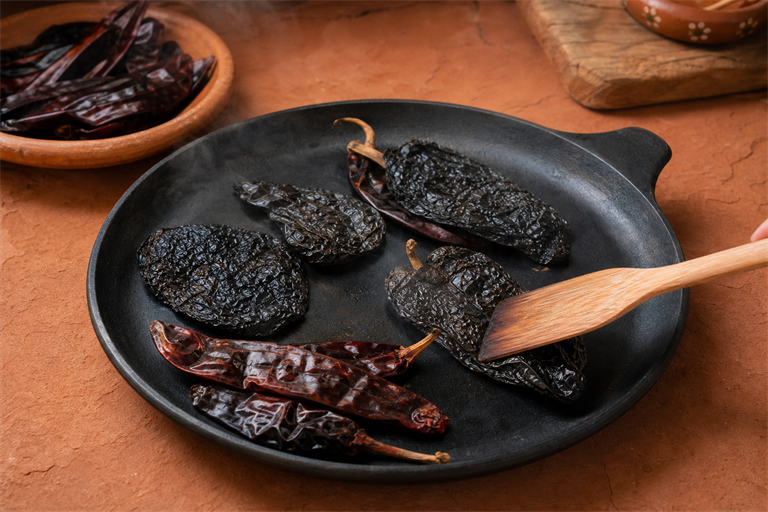
You cannot skip the chile trinity. Ancho, mulato, and pasilla are the three dried chiles that make mole poblano poblano and not a different sauce from a different state. Ancho is sweet and raisin-like (dried poblano). Mulato is darker, smokier, almost chocolatey, a different dried poblano picked riper on the plant. Pasilla is the long black one, with a sharp tobacco edge (dried chilaca). A small chipotle meco gets folded in for smoke and a quiet sting.
You also cannot skip lard. Frying the chile paste and the nut-seed paste in pork lard is what turns mole from a blended soup into a sauce with body. Vegetable oil works in an emergency, but the mouthfeel runs thinner and the flavour stays flatter.
What you can skip in an afternoon version: making your own chicken stock from scratch (use good store-bought, or quick poached broth from the chicken you’ll serve), and grinding the chocolate by hand. A tablet of Mexican chocolate, Ibarra or Abuelita, or a Oaxacan brand if you can find one, is fine.
The chiles, the seeds, the spices
For the chile paste
- 6 ancho chiles, stemmed and seeded
- 6 mulato chiles, stemmed and seeded
- 4 pasilla chiles, stemmed and seeded
- 1 chipotle meco (dried), stemmed
- 80 g pork lard
For the nut and seed paste
- 50 g raw almonds, skin on
- 50 g raw peanuts, skin on
- 40 g raw pumpkin seeds (pepitas)
- 30 g raw sesame seeds, plus 2 tablespoons more for garnish
- 1 stale corn tortilla, torn
- 1 thick slice of stale white bread (bolillo if you have it)
- 2 ripe plum tomatoes
- 4 small tomatillos, husked
- 1 medium white onion, halved
- 4 garlic cloves, unpeeled
- 60 g pork lard
For the spice and aromatic mix
- 1 stick Mexican canela (true cinnamon, not cassia), about 5 cm
- 4 whole cloves
- 6 black peppercorns
- 4 allspice berries
- 1 teaspoon dried Mexican oregano
- 2 tablets (about 90 g) Mexican chocolate, chopped
- 1.5 L warm chicken broth (homemade or good quality store-bought)
- Sea salt, to taste, start with 2 teaspoons
- 1 tablespoon sugar (only if your chiles run bitter)
Equipment
- A heavy comal or cast iron skillet
- A wide, heavy pot (5–6 L), enamel or clay
- A high-powered blender
- A fine-mesh strainer (chinois if you have one)
- A wooden spoon long enough to reach the bottom of the pot
Instructions
-
Wipe the chiles clean with a damp cloth, then stem and seed them. Heat a dry comal over medium-low. Toast the anchos, mulatos, and pasillas one variety at a time, 15–20 seconds per side, pressing them flat with a spatula. They should turn pliable and smell like dried fruit and cocoa. You should never see smoke. A burned chile makes the whole pot bitter. Toast the chipotle meco for 10 seconds only; it scorches fast.
-
Move the toasted chiles to a bowl, cover with hot water (just off the boil), weight them down with a small plate, and soak 25–30 minutes until fully soft. The soaking water will be dark and slightly bitter. Reserve a cup, but don’t use it as the main liquid. Broth carries the flavour better.
-
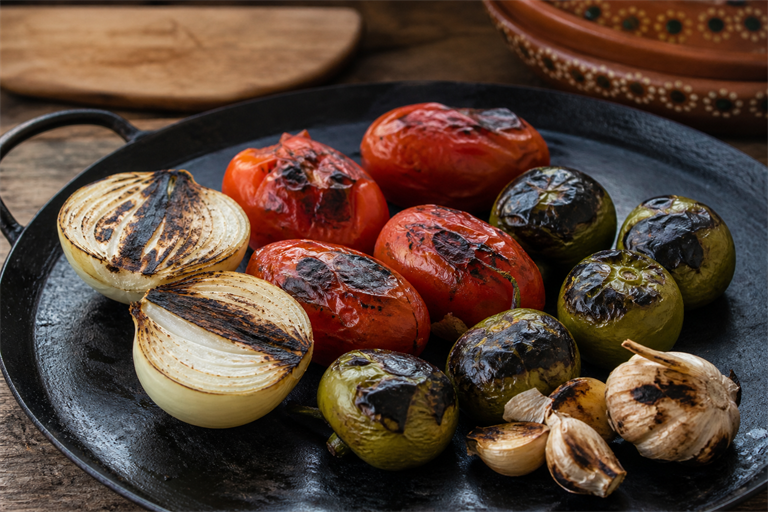
While the chiles soak, char the aromatics on the same comal. Halve the onion, then place it cut-side down with the unpeeled garlic, tomatoes, and tomatillos. Char 8–10 minutes, turning, until the skins blister and blacken in patches. This dry-roasting is what gives mole its depth. Boiled tomatoes would taste flat here.
-
Toast the spices. On the cooler edge of the comal, toast the canela, cloves, peppercorns, and allspice for 60–90 seconds, shaking the pan, until they smell warm and sharp. Grind them fine in a spice grinder or molcajete with the oregano.
-
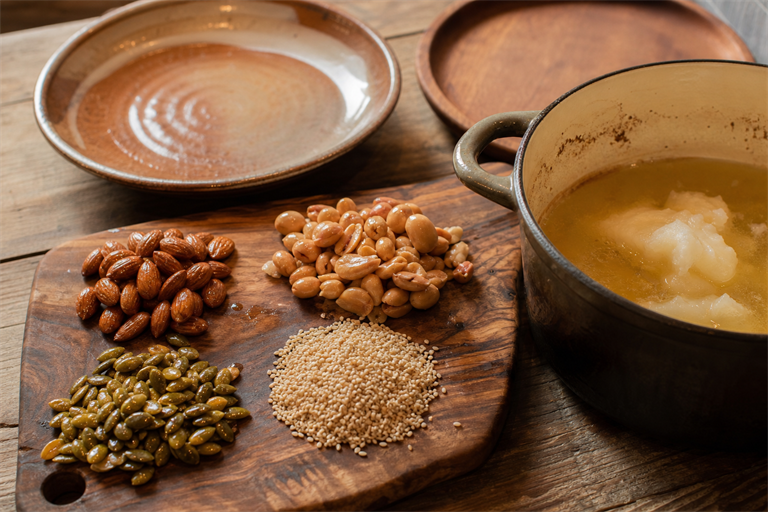
Fry the nuts and seeds in stages. In your heavy pot, melt 30 g of the lard over medium heat. Fry the almonds 2 minutes until golden, lift them out. Add the peanuts, fry 90 seconds. Then the pepitas, which will pop and puff in 30–45 seconds (have a lid ready). Last, the 30 g of sesame seeds, 20 seconds only, just until they turn the colour of dark honey. Frying separately matters because each one cooks at a different speed, and a single burned pepita will tinge the whole sauce.
-
Fry the bread and tortilla in the same lard until deep brown, about 2 minutes. These are your thickeners and a quiet sweetness in the finished sauce.
-
Blend in two pastes. In the blender, combine the soaked chiles with 250 ml of warm broth and blend on high for a full 2 minutes until completely smooth. Pass through the fine strainer back into a bowl. Push hard with a ladle, scrape the underside. Rinse the blender. Now blend the nuts, seeds, fried bread, tortilla, charred vegetables (peel the garlic first), and ground spices with another 300 ml of broth until silky. Strain this too.
-
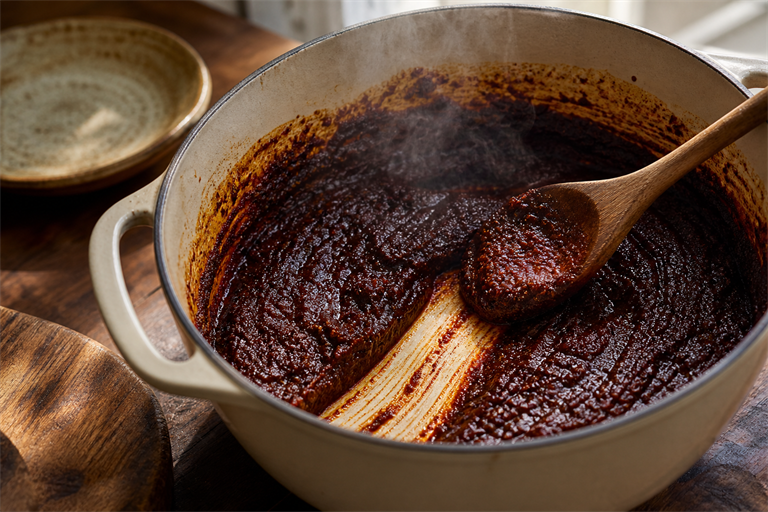
Fry the chile paste. In the same heavy pot, add the remaining lard, 110 g in total, over medium heat. When it shimmers, pour in the chile paste. It will spit aggressively, so stand back. Stir constantly with the wooden spoon for 8–10 minutes. The paste will darken, thicken, and start to leave a clean trail on the bottom of the pot. This step is non-negotiable: raw blended chiles taste sharp and one-dimensional. Frying them is what builds the salsa madre.
-
Add the nut-seed paste and stir for 3–4 minutes until the two pastes become one. Then pour in the rest of the warm broth, about 1 L, and bring it to a gentle simmer.
-
Add the chopped Mexican chocolate and 2 teaspoons of salt. Stir until the chocolate melts. Now lower the heat and let the mole simmer uncovered, stirring every few minutes, for 45 minutes to 1 hour. It should reduce by about a fifth and take on a deep mahogany sheen. When you drag the spoon, the mole closes slowly behind it. If a thin slick of red-brown fat rises to the surface, that is exactly right. It means the mole has broken properly. Skim half of it off, leave the rest for shine.
-
Taste. This is the step every recipe blog skips. Mole at this stage almost always needs one of three things: more salt (most likely), a pinch of sugar (if your chiles ran bitter), or a splash of broth (if it has tightened too much). Adjust in small increments. The flavour should be layered, sweet, then warm, then a low chile burn that arrives a full second after you swallow.
Notes from a Puebla kitchen
If your mole tastes bitter, it is almost always the chiles, either toasted too dark or soaked in their own bitter water and that water used as the main liquid. Next time, toast gentler and use broth.
If it tastes flat, the chile paste was not fried, or the lard was not hot enough. The Maillard browning of the paste is where roughly 40% of the flavour comes from. Chile paste simmered straight into broth stays thin and chocolate-tinged; the same paste passed through hot lard first takes on a low resinous hum at the back of the throat that makes mole mole.
Mole keeps beautifully. Refrigerated, it improves for three days. Frozen in portions, six months. Many Puebla cooks insist mole is better on day two.
A small block of frozen mole, thinned with broth, becomes a weeknight enchilada sauce in twenty minutes.
If you cannot find mulato, double the ancho and add one extra pasilla. The flavour shifts, but the soul of the sauce stays.
What to serve with it
At home in Puebla, mole goes over poached turkey (mole de guajolote) for a baptism, a wedding, the saint’s day of a daughter. On a normal Sunday it goes over poached chicken thighs, scattered with toasted sesame seeds, with arroz rojo on the side and a tall stack of corn tortillas wrapped in a cloth to keep them warm. The drink is agua de jamaica, hibiscus, cold, barely sweet, or a cold Victoria beer. Leftover mole on a fried egg the next morning, with a warm tortilla, is the quiet meal a Poblana cook makes for herself.