
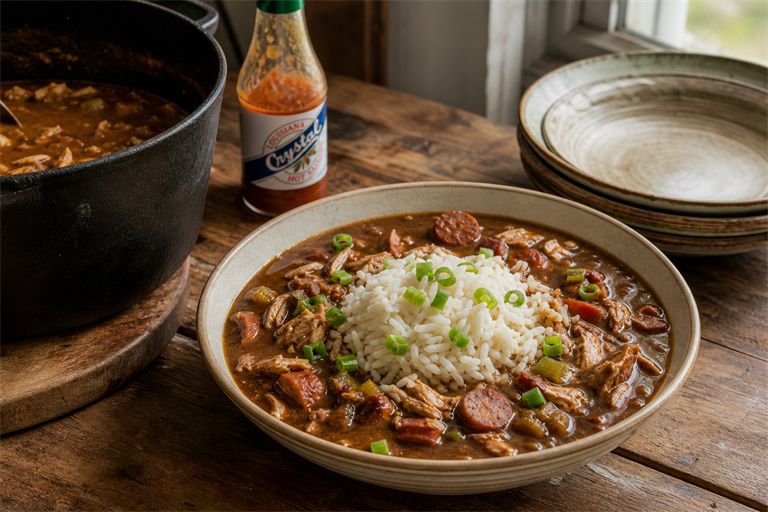

Browned flour and bay leaf fill the kitchen while a cast iron pot sits low from mid-morning and the roux moves steadily toward the color of an old penny. By one o’clock the gumbo has been simmering two hours. The dark roux smells almost like coffee, warm and faintly bitter.
This chicken-and-sausage gumbo follows the dark-roux style of the Acadiana parishes south and west of Lafayette. The roux alone runs about 45 minutes. The whole pot wants three hours, lid mostly off, fire mostly low. It’s a Sunday cook. There is no shortcut.
The hardest part isn’t the recipe. You cannot walk away from the roux, not for a minute, not to answer the phone. A Lodge cast iron Dutch oven over medium-low heat gives the lard and flour an even pace, but the timer is only a checkpoint. A reading of 47 says to look closely for penny brown and trust the toasted aroma before moving on. Get that part right and the rest is patience.
| Yield | 6 servings |
| Prep time | 25 minutes |
| Cook time | 3 hours |
| Total time | 3 hours 25 minutes |
| Difficulty | Intermediate |
The fork in the road: Cajun or Creole
Before you light the burner, pick a side. Cajun gumbo from the bayou country runs darker, skips tomato, and leans on andouille. Creole gumbo from New Orleans is brighter, often holds a little tomato, and tends toward seafood. What follows is the Cajun version Cécile cooked.
| Choice | Cajun (Acadiana) | Creole (New Orleans) |
|---|---|---|
| Roux color | Dark chocolate, near coffee | Peanut butter to milk chocolate |
| Tomato | None | Often a small amount |
| Main proteins | Chicken and andouille | Shrimp, crab, ham |
| Stock base | Roasted chicken bones | Shrimp shells |
| Thickener | Filé or okra, rarely both | Often okra and filé together |
Ingredients
For the dark roux
- 240 ml neutral oil (or 240 g lard)
- 200 g all-purpose flour
For the pot
- 1 large yellow onion, finely diced (about 350 g)
- 2 celery ribs, finely diced (about 150 g)
- 1 green bell pepper, finely diced (about 200 g)
- 6 garlic cloves, minced
- 2 bay leaves
- 2 tsp sweet paprika
- 1 tsp cayenne (start low; adjust at the end)
- 1 tsp dried thyme
- 1 tsp kosher salt, plus more to taste
- 1.5 L chicken stock, kept warm on the back burner
- 700 g bone-in chicken thighs, skin removed
- 450 g andouille sausage, sliced 1 cm thick
- 3 green onions, sliced thin
For thickening (pick one)
- 1 tbsp filé powder (ground sassafras leaf)
- or 200 g fresh okra, sliced 1 cm thick
For serving
- 600 g cooked long-grain white rice
- Crystal or Tabasco hot sauce
Equipment
- Heavy 5–6 L cast iron or enameled Dutch oven
- Flat-edged wooden roux spoon, long-handled
Instructions
-
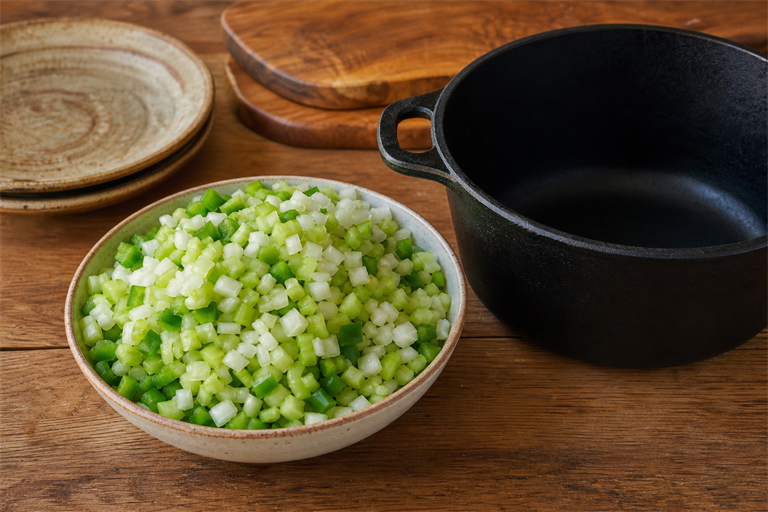
Dice the trinity (onion, celery, bell pepper) and pile all three in one bowl. Keep it within arm’s reach of the stove. Once the roux is dark you have about ten seconds to stop it, and reaching for a cutting board will cost you the pot.
-
Heat 240 ml oil in the Dutch oven over medium-low for 3 minutes. The oil should shimmer, never smoke. Smoke at this stage means the burner is too hot. A too-hot start is the most common way home cooks end up with a burnt roux at minute 20.
-
Whisk in 200 g flour all at once. It will look like wet sand. From this point on, you cannot stop stirring. Work the flat edge of the spoon around the bottom and corners of the pot in slow figure-eights for the next 40 to 50 minutes.
-
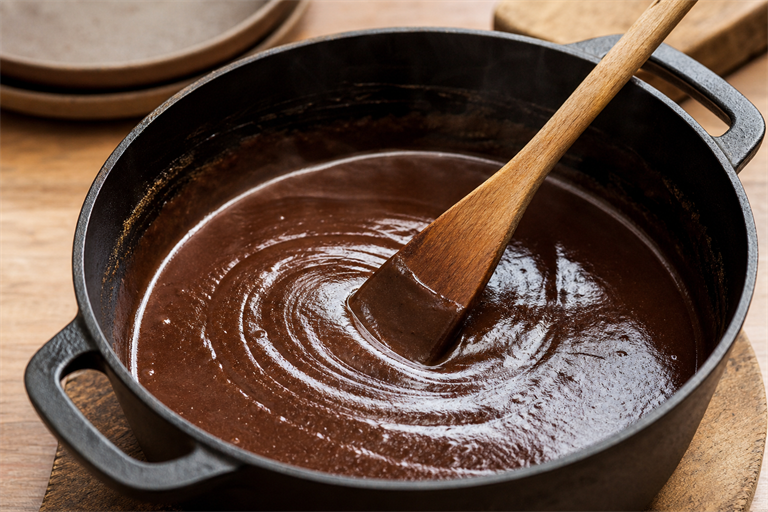
Read the roux by color and smell, not by the clock. Blonde around 5 minutes, smelling like pie crust. Peanut butter around 15 minutes, nutty. Milk chocolate around 25 minutes, toasted. Dark chocolate around 35 minutes, smelling like roasted coffee. Penny brown, almost black, around 45 minutes. That last stage is where Cajun gumbo lives.
-
Trust your nose. A sweet, toasted smell means you’re on track. A sharp, acrid smell means the heat is too high; turn it down a notch and keep stirring. Black specks in the roux mean it’s burnt: throw it out and start over. There is no fixing specks.
-
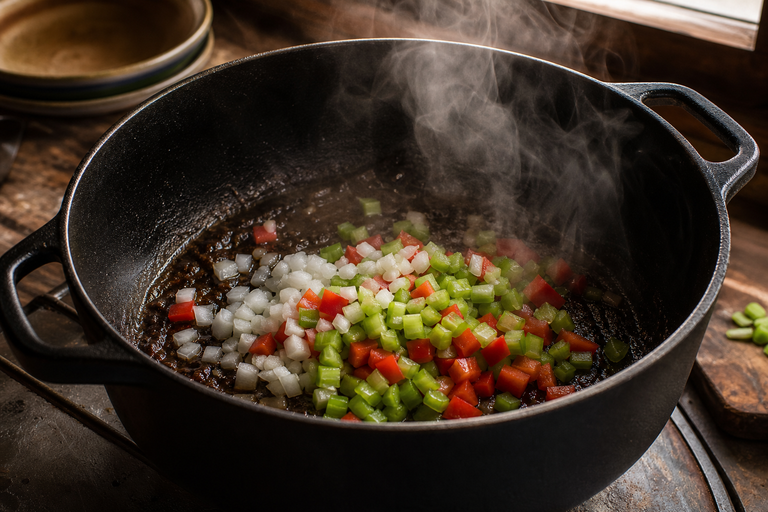
The instant the roux hits penny color, dump the whole bowl of trinity in at once. The pot will hiss loud and steam hard. The cold vegetables drop the temperature fast and stop the roux from cooking further. Stir for 4 minutes until the vegetables soften.
-
Add garlic, paprika, cayenne, thyme, bay, and salt. Stir for 1 minute until the spices wake up.
-
Pour in 1.5 L warm stock in a slow stream, whisking constantly. Cold stock will seize the roux into lumps. Bring the pot to a low simmer, about 200F (95C). Big rolling bubbles mean too hot. Settle it down.
-
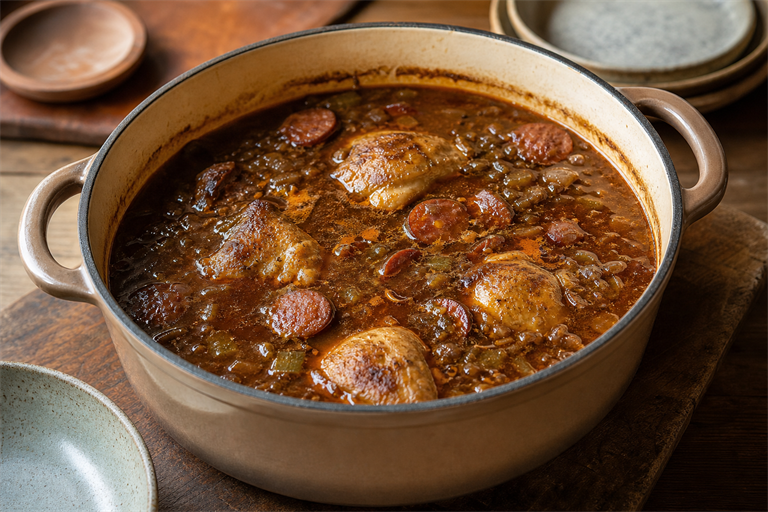
Slide in the chicken thighs and andouille. Simmer uncovered for 90 minutes, stirring every 15 minutes and skimming the orange fat that pools on top. Skimming is what separates a clean gumbo from a greasy one.
-
Pull the chicken out, shred the meat off the bones with two forks, and return the meat to the pot. Discard the bones. Taste the broth. Add salt by quarter-teaspoons until it lands, then cayenne if you want heat.
-
If you’re using okra, stir the sliced 200 g okra in now and cook 10 more minutes. For filé, pull the pot off the heat first, then whisk in 1 tbsp filé powder. Never boil filé. It turns stringy.
Notes
- Lard or bacon fat in place of neutral oil gives the roux a deeper, older flavor, the way Acadiana cooks built it before vegetable oil reached the country stores.
- True Louisiana andouille (LaPlace andouille if you can find it) is smokier and coarser than supermarket andouille. Polish kielbasa is the closest substitute outside the South.
- Seafood gumbo uses the same dark roux, but build the stock from shrimp shells. Add shrimp in the last 5 minutes only. Overcooked shrimp ruin the pot.
- Skip the filé and the okra if both feel like too much. The dark roux is doing the real thickening work.
- Gumbo tastes better on day two. The roux flavor settles, the fat re-emulsifies, the spice mellows. Cook it Saturday for Sunday lunch if you can.
What to serve with
Spoon about 100 g cooked long-grain white rice into the center of a shallow bowl. Ladle gumbo around it, not over it, so the rice keeps its shape. Sliced green onions on top. Crystal hot sauce on the table, cold beer or sweet iced tea beside it. Cover the rest of the pot, let it rest in the fridge overnight, and reheat it low and slow the next day. That second bowl is the one Acadiana cooks live for.