
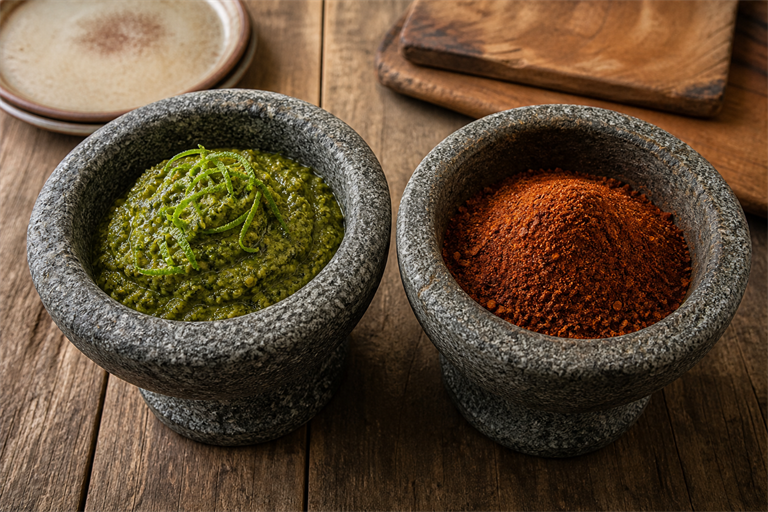

At Or Tor Kor market in Bangkok, just past five in the morning, the women at the curry paste stalls are already wet to the elbow. Galangal, lemongrass, dried chillies, shrimp paste, garlic, coriander root, all pounded in granite mortars the size of buckets, the smell so sharp it sits at the back of your throat. Two hours later, in a different time zone entirely, a Punjabi cook in Amritsar is dry-roasting coriander and cumin seeds in a heavy iron kadhai until the kitchen smells of warm earth and toasted pine. Both women are building a curry. Neither would recognise the other’s starting point as the same kind of thing.
That is the piece most English-language recipes skip. A curry paste and a curry powder are not two formats of the same idea. They are two different culinary technologies, wet versus dry, fresh versus toasted, pounded versus roasted, and the dishes built on them behave differently in the pan, on the plate, and in the mouth. Swapping one for the other does not save you a step. It gives you a different dish, usually a worse one.
The Question That Sends Cooks Wrong
Start with the practical question: can curry powder stand in for Thai curry paste? The answer is no. A Thai green curry built on Madras curry powder will taste of toasted cumin and turmeric, flavours that do not belong in that dish at all. In a Punjabi chicken curry, green curry paste brings raw lemongrass and shrimp paste where toasted spice and browned aromatics should lead. The two systems were developed in different climates, with different ingredients, on different stoves, to feed different meals. They are not interchangeable for the same reason olive oil and ghee are not interchangeable.
Wet Aromatics, Dry Spices: The Core Distinction
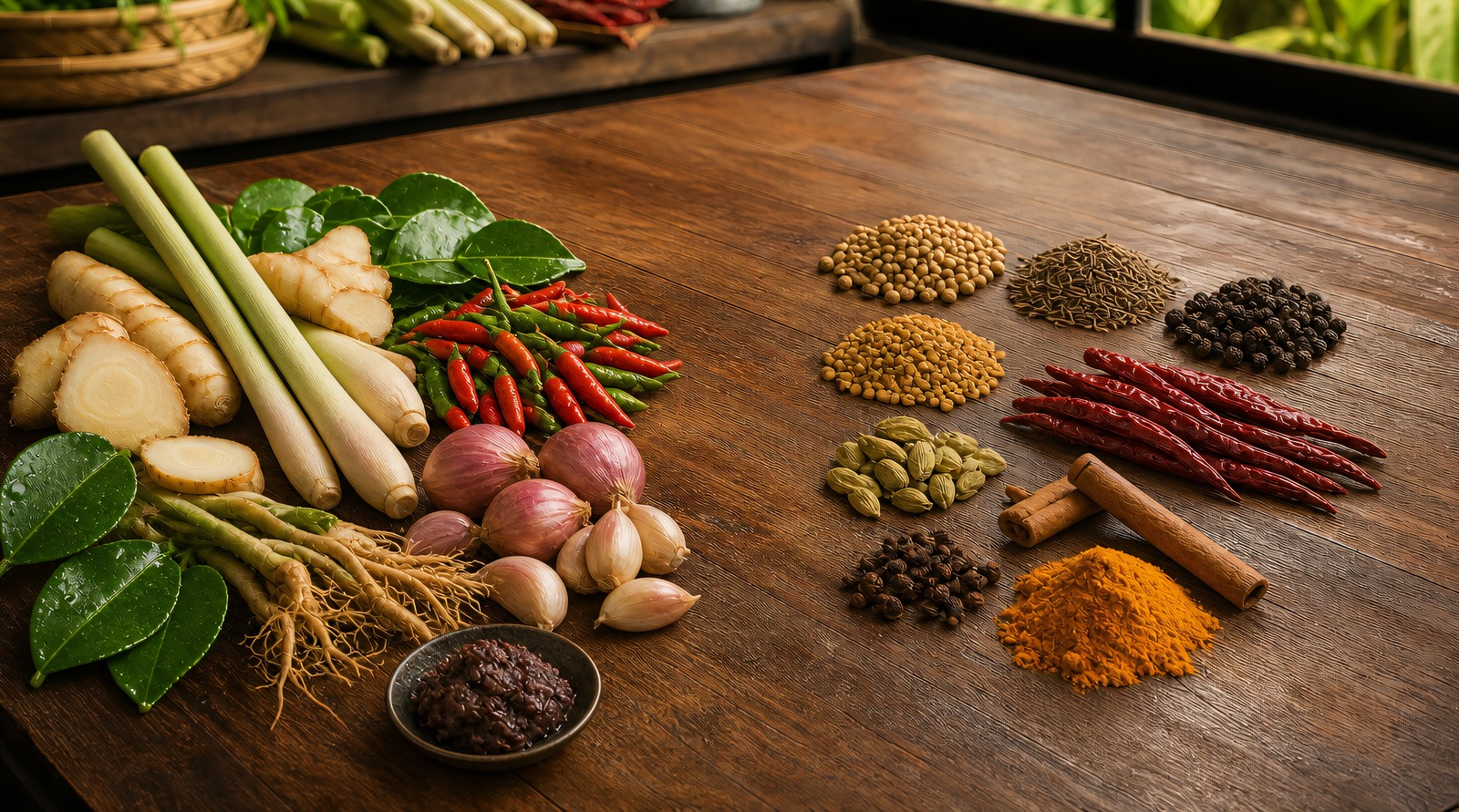
A paste, in the Southeast Asian sense (krueng gaeng in Thai, rempah in Malay and Indonesian, bumbu in Javanese), is a wet pounded mixture of fresh aromatics. The base is almost always some combination of shallots, garlic, fresh chilli, galangal, lemongrass, and shrimp paste, with regional adjustments: kaffir lime zest and coriander root in Thai green, dried red chillies and candlenuts in Malaysian rendang, turmeric root and lengkuas in Padang. The water content is real. The paste is alive. It oxidises within hours.
A powder, in the South Asian sense, is a dry blend of whole spices that have been individually toasted and then ground. Coriander, cumin, fenugreek, black pepper, cloves, cardamom, cinnamon, dried red chilli, turmeric. The British “curry powder” sold under brand names like Sharwood’s (founded 1889) is a colonial-era simplification of the Tamil kari podi and the Punjabi garam masala, flattened into a single jar for export. In actual Indian home cooking, no one reaches for a single curry powder. They build a masala for the dish in front of them.
Why Southeast Asia Pounds and South Asia Toasts
Climate is the short answer. Southeast Asia grows lemongrass, galangal, kaffir lime, fresh turmeric, and bird’s eye chillies year round, and they wilt within days of harvest. The pounded paste is a way of using these aromatics at their peak, while they still carry the volatile oils that make them what they are. The mortar lives on the counter because the market is two streets away.
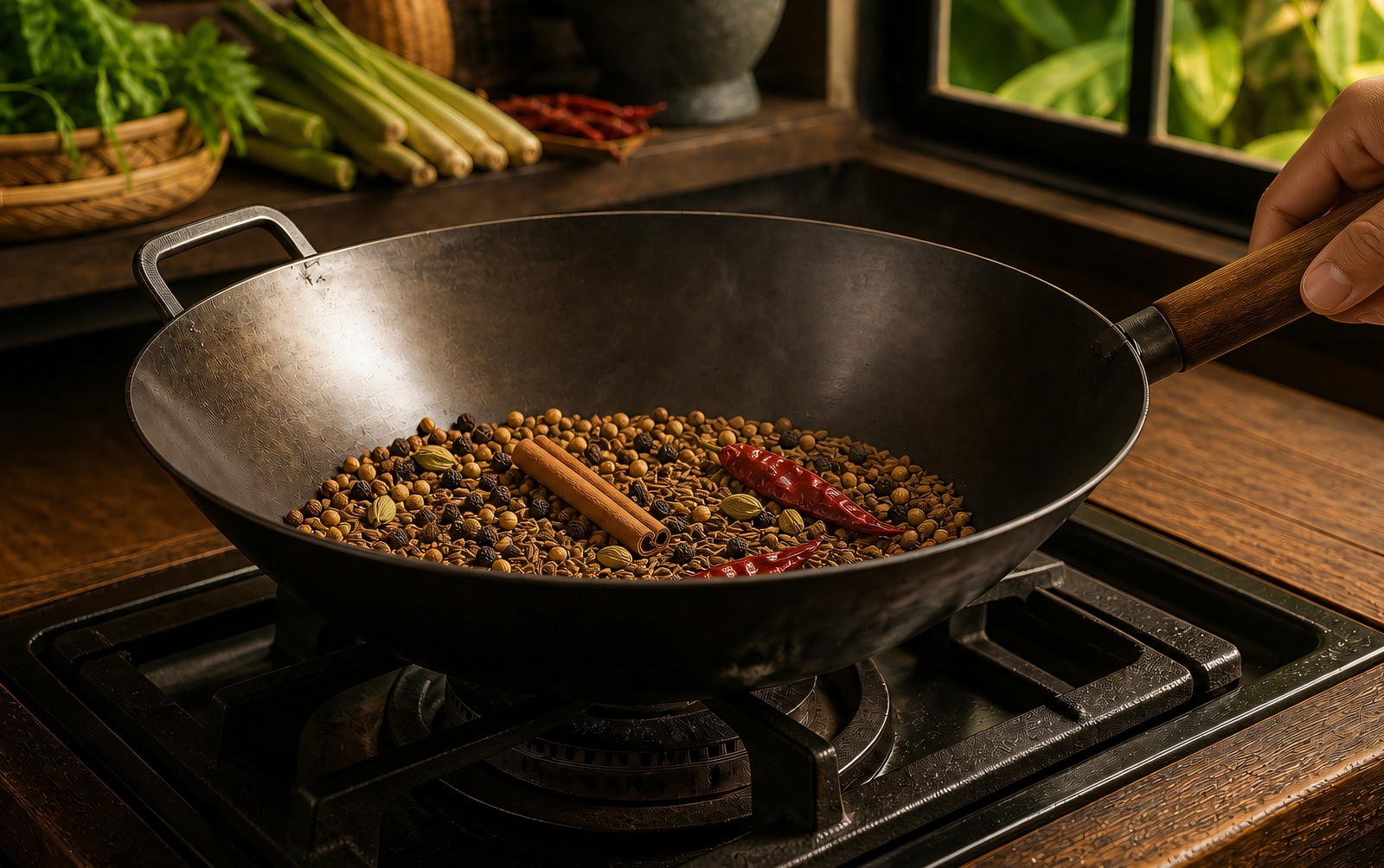
South Asia grows the same coriander, cumin, fenugreek, and black pepper, but the Mughal and Tamil traditions developed around dried whole seeds that travel and store. Toasting in a dry pan or in hot ghee (bhuna, tadka, chaunk) wakes the seeds back up. The flavour of a Punjabi kadhai chicken is built in two stages: the dry-roast of the masala, then the bloom of that powder into hot fat with onion and ginger. The technology assumes the spices have been sitting in a tin for a month, because they have.
What Actually Happens in the Pan
| Southeast Asian paste | South Asian powder | |
|---|---|---|
| Base format | Wet, pounded, fresh | Dry, toasted, ground |
| Foundation aromatics | Galangal, lemongrass, kaffir lime, shrimp paste, fresh chilli | Coriander, cumin, fenugreek, black pepper, dried chilli, turmeric |
| Fat used to cook it | Coconut cream (until oil splits) or neutral oil | Ghee, mustard oil, or neutral oil |
| First step in the pan | Fry the paste until the oil separates and the smell turns sweet, 5–8 minutes | Bloom the powder in hot fat for 30–60 seconds, often after onions |
| Cooking temperature | Medium, controlled, paste must not catch | Medium-high, brief, powder burns in seconds |
| What carries the flavour | Volatile oils from fresh herbs | Fat-soluble compounds from toasted seeds |
| Shelf life | 2–3 days fridge, 2–3 months frozen | 4–6 months sealed, then fading |
The frying of a paste in coconut cream, what Thai cooks call kati taek, “the coconut breaks,” is not optional. You stir the paste into the thick top of a can of coconut milk over medium heat, and you wait until the cream splits and a pool of red or green oil rises to the surface. That is when the paste is cooked. Before that it tastes raw and harsh. After that, it tastes round. The sound shifts too: the sizzle goes from a wet hiss to a brighter, drier crackle, and that is your cue.
The blooming of a powder is the same principle in a different format. Cumin seeds in hot ghee will sputter and darken in under a minute, and the kitchen will smell of warm wood. If you have ever made a curry that tasted dusty, it is because the powder went in with the liquid instead of into the fat first. The seeds need heat and oil to become themselves.
The Case for Powders, Honestly Made
Powders travel, store, and standardise. A jar of well-made Madras curry powder from a South Asian grocer, not the bland supermarket kind, will give a weeknight cook a credible chicken curry in forty minutes. The British Empire spread curry powder around the world for a reason: it works, it keeps, and it gives a recognisable result without a mortar. For a busy Tuesday Punjabi-style chicken, or for a Trinidadian curry goat that already belongs to the powder tradition, a powder is the right tool.
The Case for Pastes, Honestly Made
Pastes carry flavours that simply do not exist in dried form. Fresh galangal is not dried galangal. Kaffir lime zest, pounded into a paste within an hour of being grated, smells like nothing else on the shelf. A four-ounce tin of Maesri red curry paste, stocked in many Asian groceries, is a practical middle ground when fresh aromatics and a mortar are out of reach. Drop a jarred British-style curry powder into a Thai green curry recipe and the result turns toastier and more turmeric-heavy, missing the bright citrus and savoury depth of the paste.
Balance at the End
Taste the curry before you serve it. A Thai or Malaysian paste-based curry should land on four notes at once: salty from fish sauce, sweet from palm sugar, sour from lime or tamarind, hot from chilli. If it is flat, the fish sauce is usually the fix. Squid brand or Tiparos, half a teaspoon at a time. A South Asian powder-based curry lands on a different scale: salt, heat, the warmth of the toasted spices, and the tang of tomato or yoghurt. If it tastes dusty, the masala did not bloom long enough in the fat, and there is no rescue at the end. Next time, give it the thirty seconds it asked for at the start. The pan is honest about what you put into it.