
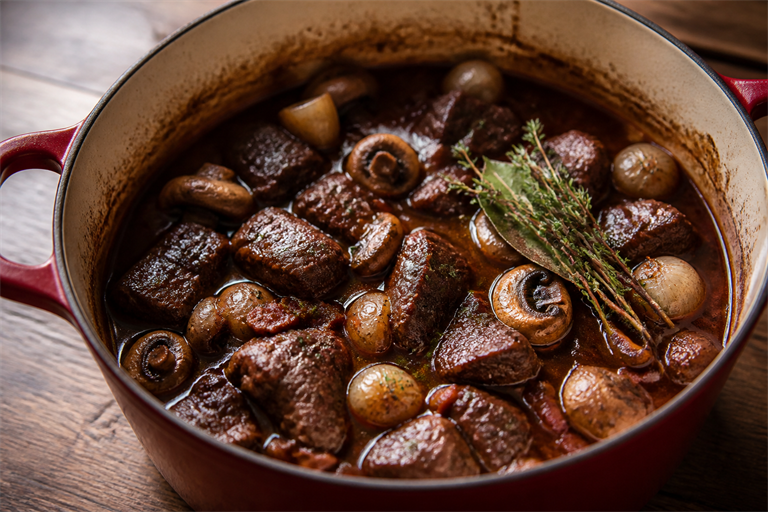

Boeuf bourguignon belongs to a Saturday rhythm: a heavy enamel pot, a lid solid enough to trap the steam, and hours to spare. The aromatic profile rarely varies. Red wine reducing with bacon fat, bay leaf, and carrots giving up their sweetness slowly. In some households the same dish goes by ragoût.
The method rewards precision at every stage. Use a 1.4 kg piece of well-marbled chuck and, for wine, a 2022 Bourgogne Pinot Noir opened the day before so the volatile alcohol has softened. The braise runs 2 hours 50 minutes at 300F (150C), then rests overnight. By the following afternoon the sauce coats the back of a spoon with a clean, glossy line.
The body of a real Bourguignon sauce comes from collagen melting into gelatin and wine reducing by half, not from flour thickening. Get the cut, the heat, and the time right, and the dish more or less makes itself.
| Yield | 4-6 servings |
| Prep time | 30 minutes |
| Cook time | 3 hours |
| Total time | 3 hours 30 minutes (plus overnight rest) |
| Difficulty | Intermediate |
Ingredients
For the braise
- 1.4 kg beef chuck or paleron, cut into 5 cm cubes
- 150 g lardons or thick-cut smoked bacon, diced
- 30 ml neutral oil
- 1 large yellow onion, diced
- 2 medium carrots, diced
- 3 garlic cloves, crushed
- 30 g all-purpose flour
- 750 ml young Pinot Noir (Bourgogne or Beaujolais)
- 250 ml beef stock
- 1 bouquet garni (2 bay leaves, 4 thyme sprigs, parsley stems tied with kitchen twine)
- Sea salt and black pepper to taste, starting with 1 tsp salt
For the garniture
- 250 g pearl onions, peeled
- 250 g button mushrooms, quartered
- 30 g unsalted butter
- 15 ml neutral oil
- 1 tsp sugar
To finish
- 20 g cold unsalted butter, cubed
- Small handful of flat-leaf parsley, finely chopped
Equipment
- 5 to 6 litre enameled cast iron Dutch oven with a tight lid
- Wide sauté pan for the garniture
- Fine-mesh strainer
The cut, the wine, and why both matter
Chuck or paleron carry the collagen that becomes gelatin and gives the sauce its body. Cut the meat into 5 cm cubes so they hold shape after three hours in the oven. Pat very dry on a kitchen towel. Surface moisture steams instead of browning, and a cube that steams will never build the crust the dish lives on.
For the wine, choose a young Pinot Noir. Tannic reds like Cabernet turn harsh and astringent after a long reduction, and a boxed cooking wine concentrates its off-flavors as the sauce thickens. A young Bourgogne or a cru Beaujolais is the reliable pick for this dish.
Render, sear, build the fond
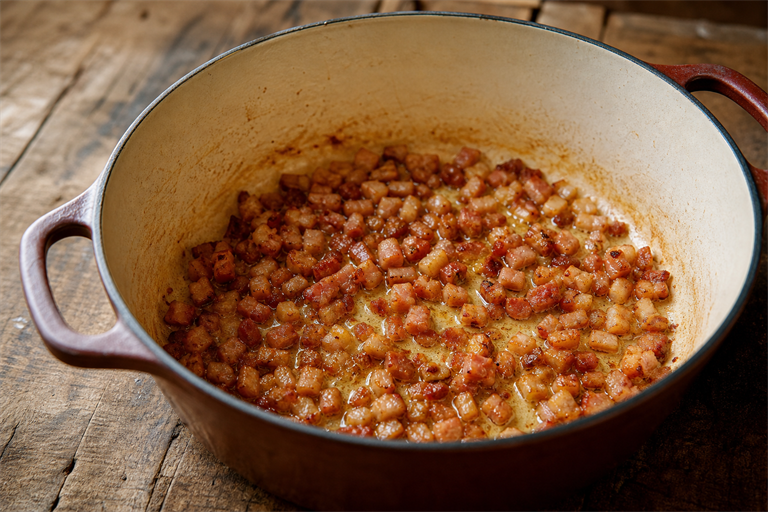
Heat 30 ml oil in the Dutch oven over medium heat. Add the lardons and cook 6-8 minutes until they have given up most of their fat and turned golden. Lift them out with a slotted spoon. That rendered fat is the base for the sear.
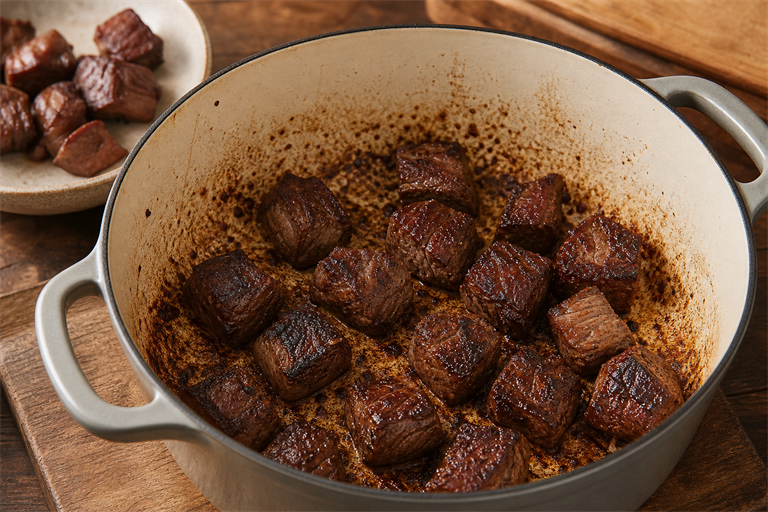
Now salt the dried beef and work in three batches. A crowded pan steams. Sear over medium-high heat, 3-4 minutes per side, until a deep mahogany crust forms on at least two faces of each cube. The brown layer welded to the bottom of the pan is the fond, and the fond is the flavor base the braise cannot fake.
Drop the heat to medium. Add onion, carrot, garlic, and a pinch of salt to the empty pot, and cook 6-8 minutes until soft and just colouring. Sprinkle the 30 g flour over and stir for 2 minutes to cook out the raw taste. Pour in 250 ml of the wine and scrape every scrap of fond off the bottom with a wooden spoon. This is the moment the dish stops being ingredients and starts being a sauce.
Building the braise (and why you don’t drown the meat)
Return the beef and lardons to the pot. Pour in the rest of the wine and the stock. The liquid should reach about two-thirds up the meat, not cover it. Full submersion boils the beef and washes flavor out; partial submersion lets it braise in steam above and liquid below. Tuck in the bouquet garni and bring it to a bare simmer.
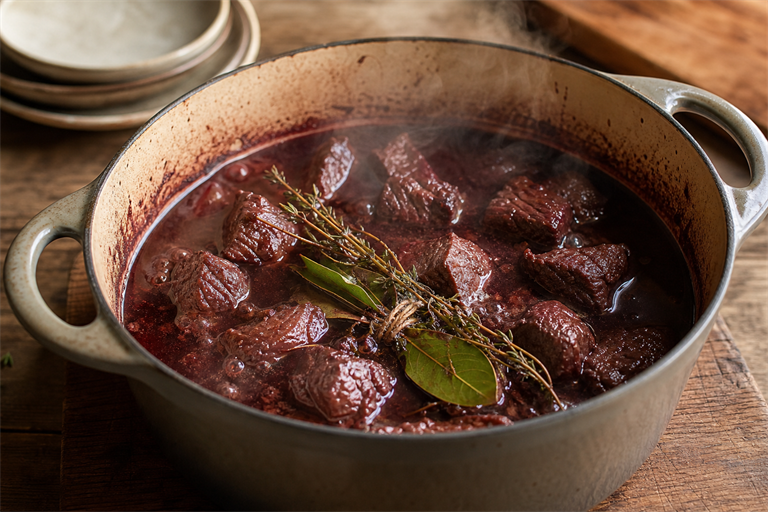
Cover with the lid set slightly ajar. Slide the pot into a 300F (150C) oven for 2.5 to 3 hours. Test at 2.5 hours by piercing a cube with a paring knife: it should slide in with no resistance, but the meat must still hold its shape. Past 3 hours 15 minutes the fibers shred and dry. Pull it the moment it is right; even twenty minutes too long and the cubes begin to collapse against the spoon.
Cook the garniture apart
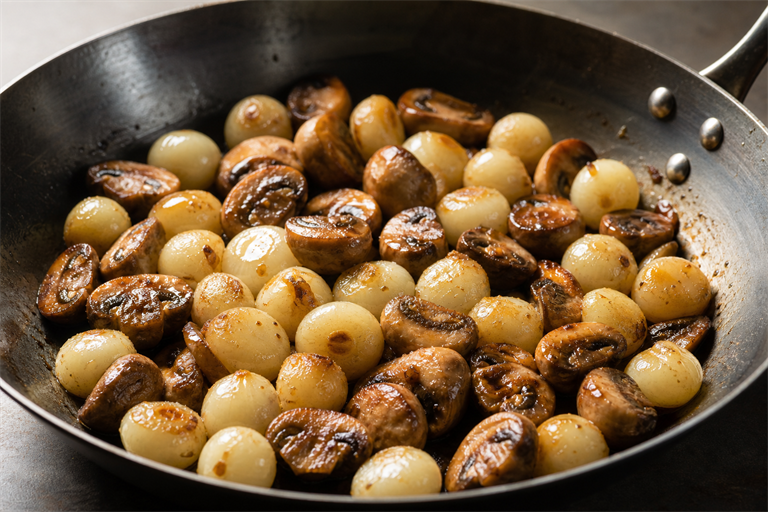
While the beef braises, melt 30 g butter with 15 ml oil in a wide pan over medium heat. Add the pearl onions, 1 tsp sugar, a pinch of salt, and 60 ml water. Cover, cook 10 minutes, then uncover and cook 5 minutes more until the water evaporates and the onions glaze golden. Lift them out. Raise the heat and sear the mushrooms in a single layer, 5-6 minutes, until deeply browned.
Cooked inside the braise they go grey and watery. Cooked apart, they stay distinct, and you keep two textures on the plate instead of one slurry.
Strain, reduce, rest overnight
Lift the beef out gently. Strain the braising liquid through a fine sieve, pressing the spent vegetables lightly. Return the liquid to a wide pan and reduce over medium heat by about a third, 12-15 minutes, until it coats the back of a spoon. Combine beef, garniture, and sauce. Cool and refrigerate overnight.
The rest is the single biggest improvement. Flavors marry, fat rises so it can be lifted off cleanly the next morning, and the sauce sets. Bourguignon served on the same day it is cooked rarely reads the way it should.
Reheat and monter au beurre
The next day, lift the solid fat off the top. Warm the stew over very low heat, covered, until just steaming. Off the heat, swirl in 20 g of cold cubed butter until the sauce turns glossy. Taste and adjust salt: cold dulls salt, so a final correction is always needed. Scatter parsley over the top.
Notes
| Wine type | Use? | Why |
|---|---|---|
| Young Pinot Noir | Yes | Balanced acid and fruit; reduces cleanly |
| Cru Beaujolais | Yes | Light tannin, bright fruit, classic alternative |
| Cabernet Sauvignon | No | Tannins turn bitter and astringent after 3 hours |
| Boxed cooking wine | No | Off-flavors concentrate as the sauce reduces |
- Thin sauce: keep reducing before you add the butter, or whisk in 1 tsp of beurre manié (equal soft butter and flour mashed together) and simmer 2 minutes.
- Tough meat: the answer is always more time at 300F (150C), never higher heat. Collagen melts on time, not temperature.
- Harsh, sharp flavor: the wine was too tannic, or it reduced uncovered for too long. A tiny pinch of sugar pulls it back.
- Muddy, bitter background: the fond burnt during the sear. Next time, lower the heat the moment the bottom darkens past mahogany.
- Cut swaps: short ribs and brisket both work. Leg or round are too lean. No collagen, no sauce body.
What to serve with
In Burgundy, this is a Sunday lunch dish. Serve it over wide buttered egg noodles or a soft potato puree, with the same Pinot Noir that went into the pot and a crisp baguette to wipe the plate. The one detail a classically trained French cook would never skip: a small spoonful of Dijon on the side of the plate, stirred into the sauce one bite at a time. If long, collagen-driven braises like this appeal, the same patient logic shows up in a Fez-style chicken tagine with preserved lemon and in a Punjabi bhuna chicken curry, where time, not heat, does the work.