
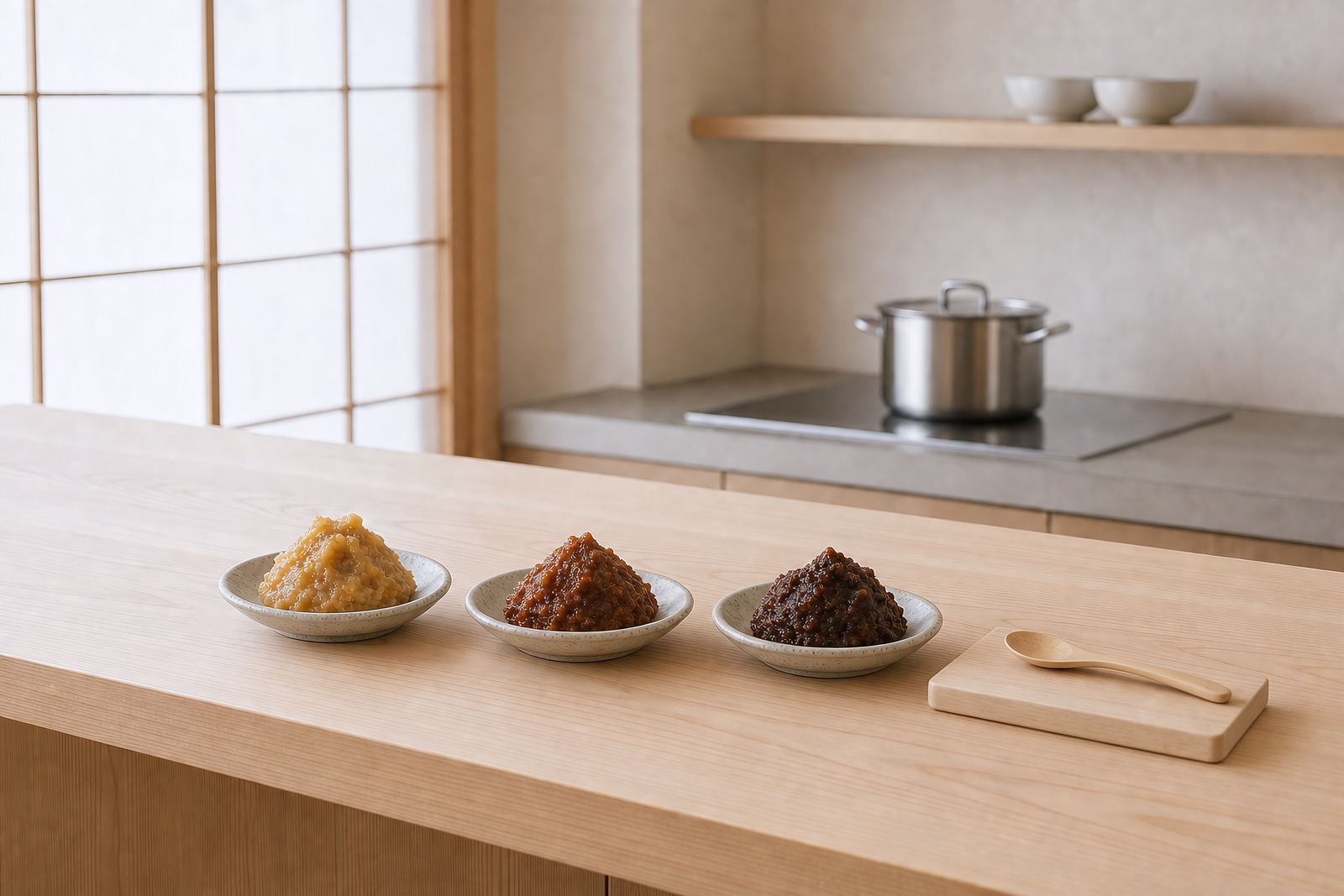
Traditional miso shops in central Kyoto keep their pastes in open wooden tubs. The lightest is pale straw, the colour of new tatami. Beside it, the darkest looks like wet earth after rain. Saikyo miso is often sold wrapped in paper, still cool from the cellar. For grilled black cod, choose the palest paste in the room, a scoop of roughly 300 grams.
Miso is not three types. It is a spectrum.
What actually makes miso white, red, or mixed
Miso is soybeans, salt, and koji. Koji is a grain seeded with the mold Aspergillus oryzae. The grain is usually rice, sometimes barley, sometimes the soybeans themselves.
Two numbers do most of the work: the koji-to-soybean ratio, and the aging time. Salt sits alongside them.
- Shiro (white): high koji, short age (a few weeks to a few months), lower salt around 5–7%. Sweet, mild. On the tongue it registers first as sugar, then as bean.
- Aka (red): less koji, long age (one to three years), higher salt around 11–13%. Deep, savoury, sharp. It coats the back of the throat.
- Awase (mixed): shiro and aka blended, sometimes at the factory, more often in a home cook’s bowl.
Colour is a clue, not the cause. A miso darkens because the Maillard reaction runs longer. Longer time, less koji sweetness, more depth.
Shiro: the paste for delicate things
Saikyo miso from Kyoto is the classic shiro. It can be almost 12% koji by weight. It ages only three or four weeks. It tastes closer to sweet white bean paste than to soup base. Rub a pinch between your fingers and it feels smooth, almost like room-temperature butter.
Shiro suits these dishes:
- Marinades for fish. Black cod sits in 200 g saikyo miso, 2 tablespoons mirin, and 2 tablespoons sake. Two nights in the fridge. The koji enzymes soften the flesh. The sugar browns under the grill in about four minutes, edges just past mahogany.
- Light dressings. Whisk 1 tablespoon shiro with 1 teaspoon rice vinegar and a splash of dashi. Spoon it over blanched spinach.
- Sunomono-style dips for cucumber or wakame.
- Suimono (clear soups) at the end of winter, when you want warmth without weight.
Shiro breaks down fast in heat. Add it at the end of cooking, off the flame.
Aka: the paste for stews and glazes
Aka miso is the other pole. Sendai miso is aged around a year. Hatcho miso from Aichi is made from pure soybean koji, no rice at all. It ages in cedar barrels under river stones for two to three years. It is almost black. It tastes of chocolate and roasted seeds, with a faint dryness like unsweetened cocoa.
Aka fits when the dish is already heavy.
- Nikomi (long stews): a pork and daikon nikomi with 3 tablespoons aka miso stirred in during the last twenty minutes.
- Glazes for aubergine. Aka miso, mirin, sake, sugar, in equal parts. Grill until it blisters, roughly 3 minutes under a hot broiler.
- Red miso soup with clams, where a pale miso would vanish.
- Dengaku on tofu or konnyaku.
Aka can take gentle heat longer than shiro. It still should not boil hard. A rolling boil kills the aroma in any miso. Hold the pot at 80 to 85°C once the paste goes in.
The middle: awase and the regional pastes at a glance
Keep two pastes and blend them to make awase. Adjusting the balance lets the miso fit the meal on the day.
| Miso | Region | Koji base | Age | Salt | Best for |
|---|---|---|---|---|---|
| Saikyo | Kyoto | Rice, high koji | 3–4 weeks | ~5% | Fish marinades, sweet dressings |
| Shinshu | Nagano | Rice | 6–12 months | ~12% | Everyday miso soup, workhorse awase |
| Sendai | Miyagi | Rice | ~12 months | ~13% | Robust soups, braises |
| Hatcho | Aichi | Soybean only | 2–3 years | ~10% | Nikomi udon, dark stews, glazes |
| Mugi | Kyushu | Barley | 6–18 months | ~10% | Country soups, root vegetables |
Shinshu is a versatile default. If you buy only one miso, buy a mid-aged Shinshu. A 750 g tub of Marukome Shinshu kept in the refrigerator door will hold its colour through most of a season.
Swapping and blending in a recipe you already own
A recipe says “3 tablespoons white miso.” You only have aka. What now?
- Aka in place of shiro: use two-thirds the amount, add half a teaspoon of sugar or mirin, and taste.
- Shiro in place of aka: use one and a quarter times the amount, add a splash of shoyu for depth.
- Awase on the fly: 2 parts Shinshu, 1 part Saikyo for a gentle soup. 1 part Shinshu, 1 part Hatcho for a wintry one.
The rescue for any over-salty miso dish is a spoon of grated daikon or a little more dashi, never water.
Storage, heat, and how miso meets dashi
Miso is alive. Keep it in the fridge in its tub with a piece of parchment pressed to the surface. Shiro keeps well for about three months once opened. Aka keeps six months or longer, and darkens slowly. That is fine.
Do not boil miso. Bring your dashi to a bare simmer, around 90°C, small bubbles at the edge of the pot only. Take it off the heat. Ladle a little into a small bowl. Dissolve the miso there with the back of a spoon. Pour it back. This is the standard Kyoto method still used in home kitchens today.
Dashi and miso are the same conversation. A clean katsuo-kombu dashi wants shiro or a light Shinshu. A stronger iriko (dried sardine) dashi wants aka or Hatcho. Match the weight of the broth to the weight of the paste.
When you finish a tub, do not throw the smear at the bottom away. Loosen it with a spoonful of hot dashi, about 30 ml. Pour it into tomorrow’s soup. The pot will taste of every soup that came before it.