
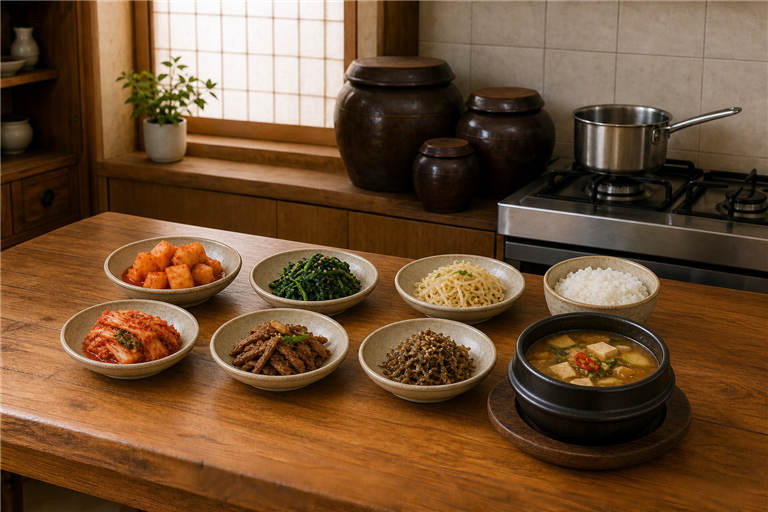

A first-time visitor to a small Korean restaurant often meets the same welcome. Before the main food arrives, the server sets down eight small plates: cold cabbage kimchi glossy with chile, a saucer of tiny anchovies, spinach the color of a wet leaf. The question that follows tends to be the same: “Is this the meal?” No. This is banchan (반찬), and it is doing quiet, specific work.
A Korean home cook composing a banchan spread pulls small plates from the refrigerator drawer the way other people pull books off a shelf. Kimchi (김치) from the big jar. Sigeumchi namul (시금치나물), spinach dressed with sesame and a little ganjang (간장). A tiny bowl of jangjorim (장조림), beef simmered in soy. There is no performance in it. It is the composition of a meal.
That composing is the subject worth staying with. The recipes come later. What matters first is why a Korean table carries 3, 5, or 12 small dishes, and how a home cook picks which ones on a given night.
Banchan is a structural layer, not garnish
Banchan is not the Korean answer to a side salad. It is the middle layer of a Korean meal, which is built in three parts: bap (밥, rice), guk or jjigae (국/찌개, soup or stew), and banchan. The main protein, if there is one, sits inside that structure rather than above it.
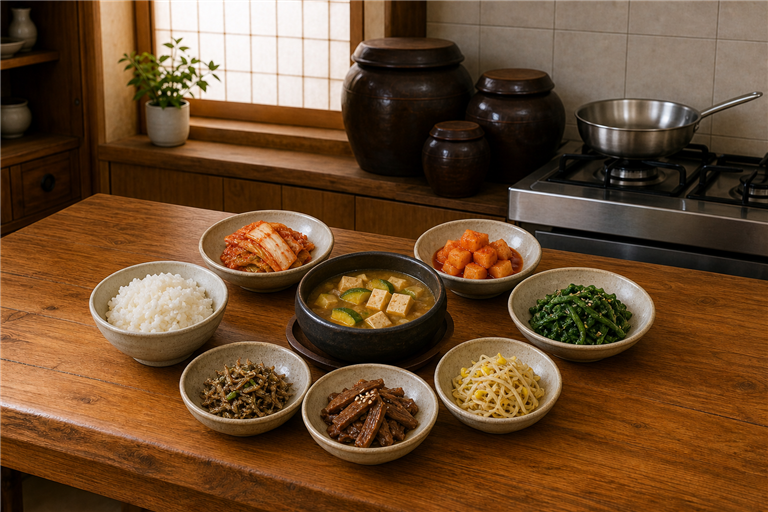
Rice is neutral. The soup is warm, salty, soft. Banchan is where the flavor gets loud, sour, spicy, sweet, crunchy, cold. Without them, every bite is the same bite. With them, you build each mouthful differently: a spoon of rice, a corner of kimchi, a strand of namul, a piece of braised beef.
The four axes a Korean cook balances
A Korean cook putting out banchan is balancing four things at once, mostly without thinking about it.
Taste. Salt from kimchi and jangjorim. Sour from young kimchi or pickled radish. Spice from gochugaru dressings. Umami from doenjang-dressed vegetables and fermented anchovy sides. And a small sweetness somewhere, often a candied bean side like kongjaban.
Texture. Crunch from raw kimchi or pickled radish. Chew from braised beef or dried anchovy. Soft from blanched greens. Three soft dishes make a boring table. A spread of three namul, no ferment, all room temperature, will feel flat. Pull a jar of kkakdugi from the fridge and everything sharpens.
Temperature. Kimchi cold from the fridge. Namul at room temperature. Jorim warm from the pan. Rice steaming, soup hot. A good spread hits your mouth at three or four temperatures.
Ferment level. At least one dish must be fermented: kimchi, kkakdugi, or a doenjang-dressed vegetable. The ferment resets your palate between rich bites, and it is what makes the meal feel Korean.
The three banchan roles
Almost every banchan on a Korean table plays one of three roles. Once you see them, you can build a spread from any refrigerator.
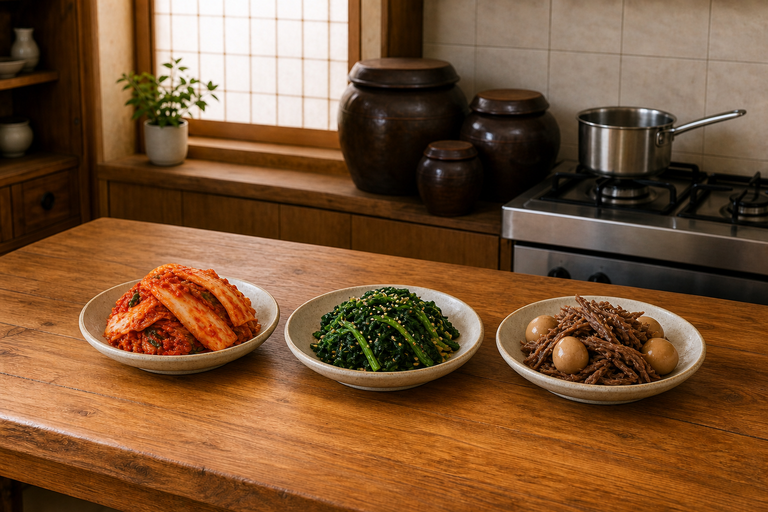
- The ferment anchor. Kimchi (배추김치), kkakdugi (깍두기, radish kimchi), or oi-sobagi (오이소박이, cucumber kimchi). Non-negotiable. This is the dish that makes the meal Korean.
- The namul (나물). A seasoned vegetable, blanched or raw, dressed with sesame oil, garlic, and a little ganjang or gochujang. Sigeumchi namul, kongnamul (soybean sprouts), musaengchae (radish salad). This is the fresh, light counterweight.
- The jorim or bokkeum (조림/볶음). A braised or stir-fried dish, usually with a protein or a starchy root: jangjorim, dubu-jorim (braised tofu), myeolchi-bokkeum (stir-fried tiny anchovies), gamja-jorim (braised potato). This is the salty, chewy piece.
Pick one from each row and you have a working spread. That is the whole trick.
Building around bap, guk, and one main
A normal weeknight spread is rice, a soup, one main dish, and three banchan chosen by role. The main might be grilled mackerel, or a small pot of dak-galbi. The soup might be doenjang jjigae with zucchini and tofu.
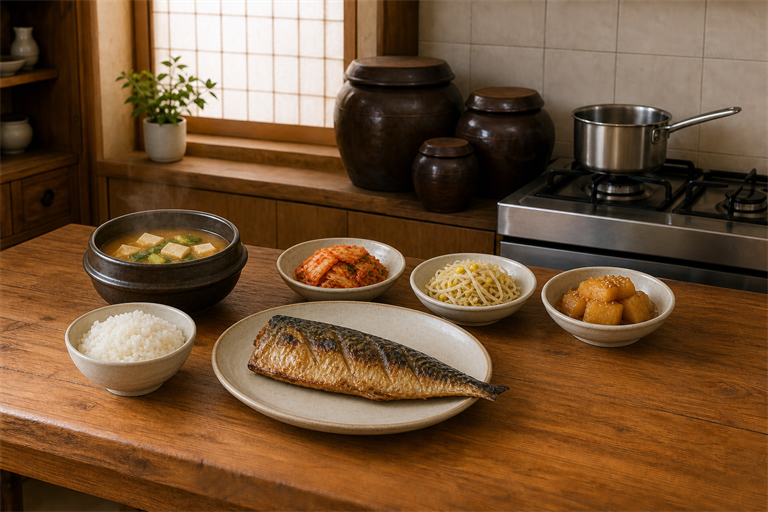
The banchan is chosen against the main. If the main is heavy and rich, the banchan runs lighter and sourer: fresher kimchi, a raw namul, a quick pickled radish. If the main is a mild fish, the banchan runs bolder: aged kimchi, jangjorim, a spicy stir-fried anchovy.
Soup and rice never change roles. Everything else negotiates around them.
A weeknight three and a weekend seven
Here is what a real Korean home cook actually does.
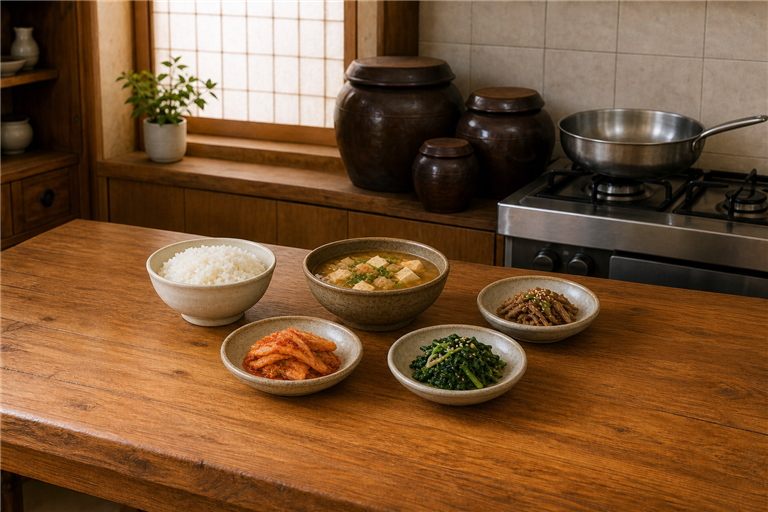
Weeknight (3 banchan). Kimchi, plus one namul, plus one jorim. That is it. Total active work: 15 minutes if the banchan came from the refrigerator drawer, which it did.
Weekend (5 to 7 banchan). Kimchi and kkakdugi. Two namul, one green and one white. Two jorim or bokkeum. A seasonal something: a cold cucumber muchim in summer, a braised lotus root in autumn. Make cooked dishes in small batches; promptly freeze portions intended for later in the week.
The weekend spread is not more cooking on the day. It is more cooking on Sunday.
Storage, and the reason banchan works
Banchan is a make-ahead system, but storage depends on the dish. Treat homemade cooked namul, jorim, and bokkeum as leftovers: refrigerate promptly at 40°F (4°C) or below, and use within 3–4 days or freeze. See USDA refrigeration guidance. For purchased kimchi and kkakdugi, follow the package’s opened-storage directions. Homemade fermented versions need a tested recipe and its specific fermentation and storage instructions; sourness alone does not establish safety.
Make three or four banchan on Sunday. Use refrigerated cooked dishes within the limit above and thaw frozen portions in the refrigerator for later meals. Tomorrow’s dinner is rice, a fresh soup, a piece of grilled fish, and the small dishes already waiting in the drawer. That is how Korean home cooking actually gets on the table on a Tuesday. Reheat the jorim if you like. Eat the namul cold. Pull the kimchi last so it stays crisp.