
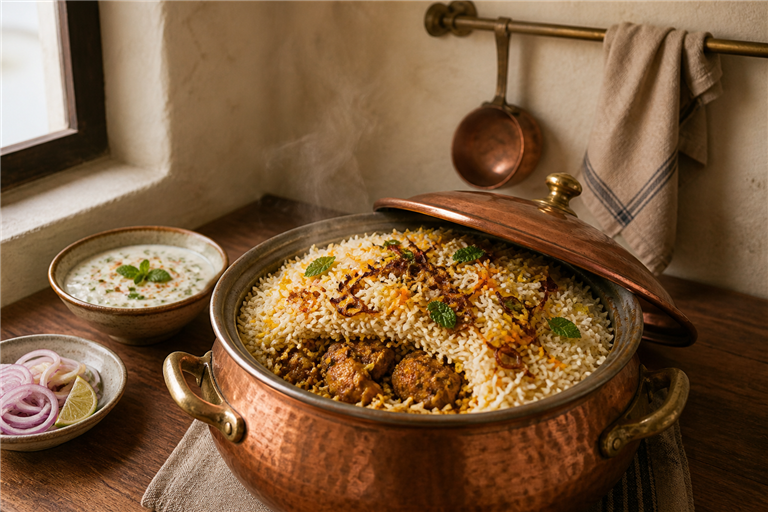

Hyderabadi biryani announces itself before the lid comes off. Ghee and fried onion first, then mint and saffron, then the slow tang of yogurt that has cooked into the chicken. Lift the lid on a good handi and the steam pushes out in one soft breath, warm with cardamom. The rice on top sits pale gold, grain by grain separate. Underneath, the meat pulls apart with a spoon.
That is kacchi dum biryani. Raw marinated chicken at the bottom, parboiled basmati on top, the pot sealed with dough, and everything cooking together in its own steam. Most home recipes teach the pakki version, where the chicken is cooked first and then layered with rice, because it is safer. The Hyderabadi one worth learning is kacchi, and the whole thing hinges on three numbers: a 3 hour marinade, 70% parboiled rice, and 10 minutes on high heat followed by 30 to 35 minutes low over a tawa.
| Yield | 4 to 5 servings |
| Prep time | 40 minutes (plus 3 hours marination) |
| Cook time | 55 minutes |
| Total time | 4 hours 35 minutes |
| Difficulty | Advanced |
Ingredients
For the birista (fried onions)
- 3 large onions (about 500 g), sliced paper-thin
- 300 ml neutral oil, for frying
For the chicken marinade
- 900 g bone-in chicken, cut into large curry pieces
- 250 g full-fat yogurt, whisked smooth
- 6 green chilies, slit lengthwise
- 2 tbsp ginger-garlic paste
- 1 tsp Kashmiri red chili powder
- 1/2 tsp turmeric
- 1 tsp garam masala
- 1 tsp shah jeera (caraway)
- 1/2 cup mint leaves, roughly torn
- 1/2 cup cilantro, chopped
- Half of the birista, crushed
- 2 tbsp lemon juice
- 2 tbsp ghee
- 1.5 tsp fine salt
For the rice
- 400 g aged basmati rice (Daawat or India Gate XXL)
- 2.5 litres water
- 2 tbsp salt
- 4 green cardamom, 2 black cardamom, 1 small cinnamon stick, 4 cloves, 1 bay leaf
- 1 tbsp neutral oil
For layering and dum
- A big pinch of saffron soaked in 60 ml warm milk
- 2 tbsp ghee, melted
- Remaining birista
- Reserved mint and cilantro
- Atta (whole wheat flour) dough or heavy foil, to seal
Equipment
- A heavy-bottomed handi, Dutch oven, or thick aluminium pot with a tight lid
- A flat tawa or cast iron griddle to sit under the handi during dum
- A wide pot for parboiling rice
- A spider or fine strainer
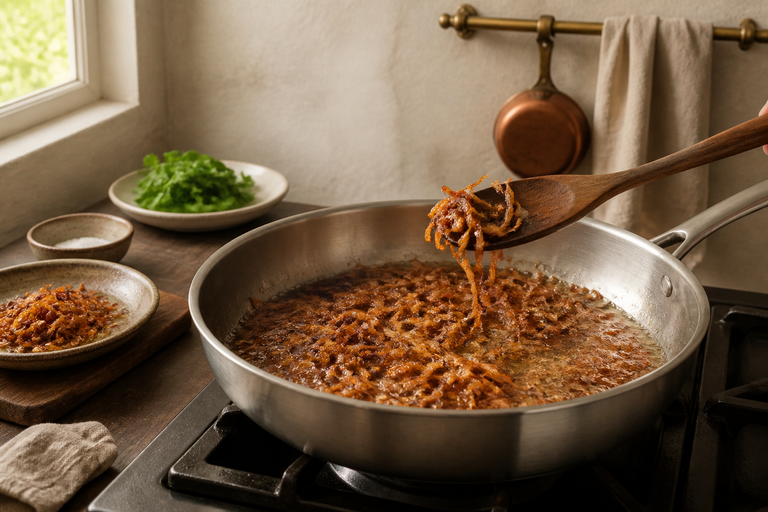
Fry the birista first
Everything else in this biryani leans on the fried onions, so start there. Heat the oil to 160C (320F) and fry the sliced onions in two batches, 8 to 10 minutes each, stirring often until they are a deep even brown, just before mahogany. Drain on paper. They will crisp as they cool. Underfry them and the biryani loses its Hyderabadi backbone. Near the end of the fry, lift one strand out at a time and check the colour against the target shade before draining the batch.
Marinade, and why 3 hours matters
Build the marinade in the pot you will cook in. Whisk the yogurt smooth, then add the green chilies, ginger-garlic paste, chili powder, turmeric, garam masala, shah jeera, mint, cilantro, half the crushed birista, lemon juice, ghee, and salt. Fold in the chicken. Cover and refrigerate for 3 to 4 hours. Marinating changes seasoning and texture; it does not make raw chicken safe to eat or guarantee that it will cook through. Keep a food thermometer ready for the final check.
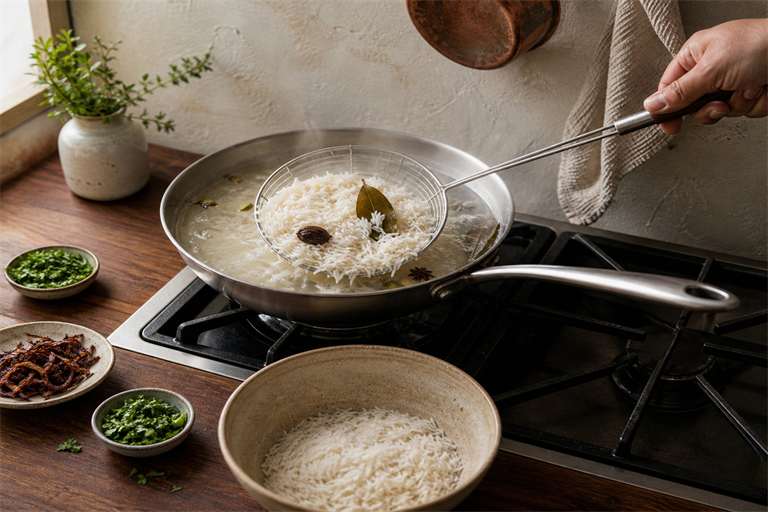
Soak, then parboil to 70%
Soak the basmati in cool water for 30 minutes, then drain. This step is not decorative. Soaked grains parboil more evenly and finish elongated instead of stubby.
Now parboil the rice to about 70%. Bring 2.5 litres of water to a rolling boil with the whole spices, salt, and oil. Add the drained rice and cook 4 to 5 minutes. Start testing at minute 3: fish out a grain, press it between your thumbnail and forefinger. It should crush with clear resistance, with a firm white core still visible. Drain immediately through a wide strainer, and do not rinse.
Layer, seal, and dum
Layer the handi with a light hand. On top of the marinated chicken, spread the hot parboiled rice in one even layer. Do not press. Drizzle the saffron milk in streaks across the surface. Pour over the melted ghee. Scatter the remaining birista, mint, and cilantro. The layers stay separate; only the steam travels.
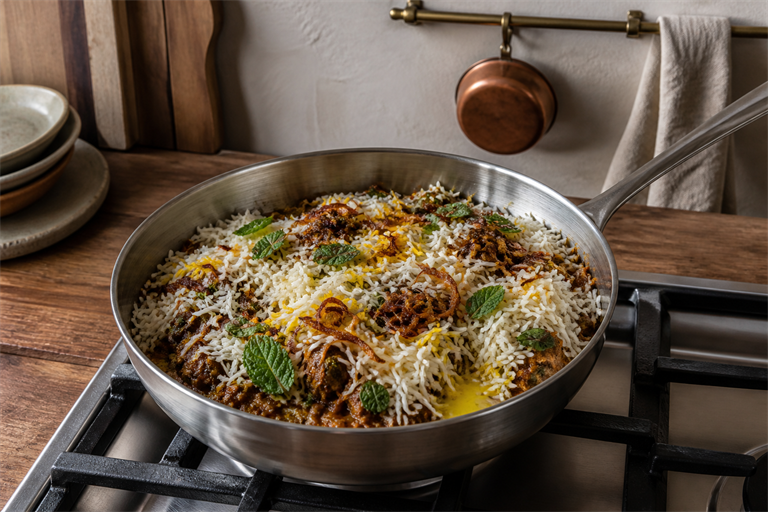
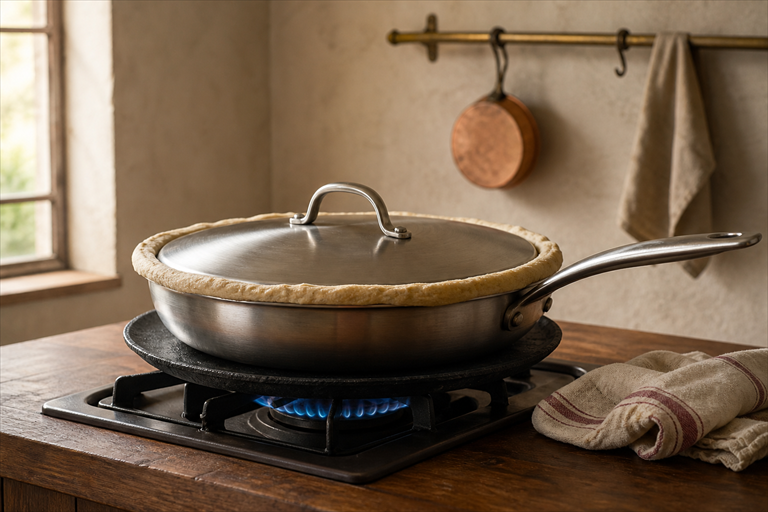
Now seal the pot. Roll a rope of stiff atta dough and press it around the rim, then clamp the lid down hard. No dough? Cover the pot tightly with heavy foil, set the lid over that, and weigh it down with a small pan of water. A weak seal is the single most common reason home dum fails.
Cook 10 minutes on medium-high heat, directly on the burner, to build steam and start the chicken. You should hear a soft hiss and see a faint dance in the lid, not a violent boil.
Then slide a flat tawa under the handi and reduce to low heat. Cook for about 30 to 35 minutes with the lid closed, monitoring the stove. Treat this as an initial cooking interval: the final thermometer check determines whether more cooking is needed.
Carefully open the lid away from your face and check several chicken pieces from different parts of the pot. Insert a food thermometer into the thickest meat without touching bone. The chicken must reach at least 74C / 165F, following USDA poultry guidance; juice color is not a safety test. If any checked piece is below that temperature, cover and continue cooking, then recheck before serving. Once the chicken is cooked and the rice is tender, turn off the heat and rest the covered pot for 10 minutes.
Fold, do not stir. Use a flat spatula and lift from the sides down to the base, turning the layers over gently in wide sections so each plate gets rice, chicken, and the browned bits from the bottom.
When something goes wrong
If the rice is mushy, you parboiled past 70%, or the seal was too tight and trapped too much water. Next time pull the rice at 4 minutes and taste.
If a chicken piece measures below 74C / 165F, continue cooking immediately with the pot covered and check again. Piece size, heat delivery, and cooking time can affect the result; a longer marinade does not correct undercooking. Do not refrigerate partly cooked chicken to finish later.
If the bottom burned, there was not enough moisture in the chicken layer, or the tawa was skipped. A tablespoon of extra ghee at the base of the pot helps on thin cookware.
A note on styles. Hyderabadi kacchi leans on green chili heat and mint. Lucknowi is gentler, perfumed with kewra and rose. Kolkata biryani adds a boiled potato and a whisper of sweet spice. Do not blend the three.
Divide leftovers into shallow containers and refrigerate within two hours, or one hour above 32C / 90F. Use within 3 to 4 days. Reheat in a covered pan with a little water until the rice and chicken reach 74C / 165F throughout; eight minutes alone is not a reliable endpoint. See USDA’s leftover guidance.
What to serve with it
Set this beside a bowl of cool boondi raita, a plate of thin-sliced onion and green chili with a squeeze of lime, and mirchi ka salan for a proper Sunday spread. Add a glass of salted chaas, and nothing else on the table. Biryani is the meal, not a side.