
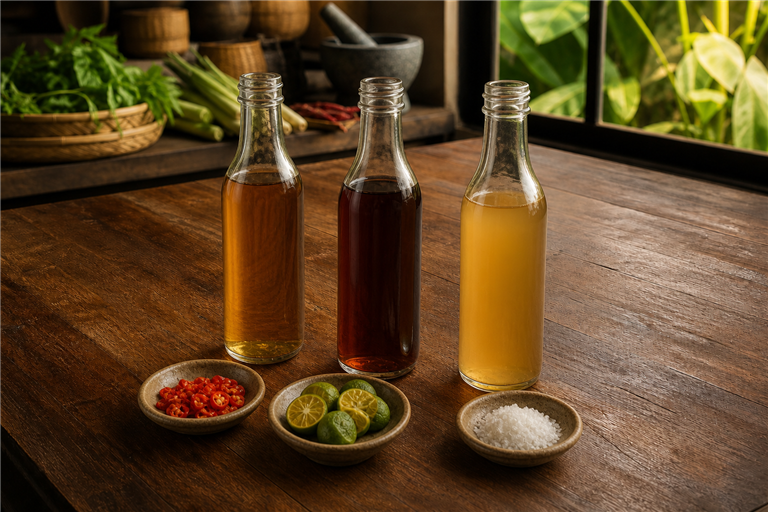

You can use a Vietnamese, Thai, or Filipino fish sauce in another cuisine, but the amount may need adjusting. The useful comparison is between the bottles you can buy: their ingredients, sodium per equal volume, and how they work in your finished dish. A country’s name alone does not tell you that one sauce will be sweeter, saltier, or better.
This is a label-based buying and substitution guide, not a blind taste test. Product examples below come from manufacturer information checked in September 2026. Check the bottle in your shop because recipes and labels can differ by market.
What the three names tell you
Nước mắm, nam pla, and patis are fish-sauce names associated with Vietnamese, Thai, and Filipino cooking respectively. They are useful terms when following a recipe or finding an ingredient in a shop. They are not standardized national flavor grades.
For example, Red Boat 40°N lists anchovy and sea salt and describes the product as first-press, barrel-aged fish sauce. Squid Brand Original Green Label for export lists anchovy 77%, salt 20%, and sugar 3%. Those are specific product differences; neither label establishes how every Vietnamese or Thai sauce tastes.
For a Filipino example, NutriAsia describes its Datu Puti Fish Sauce as made from fermented anchovy extract. That description does not support treating every bottle of patis as the same byproduct with the same production method. Read the exact product name and ingredients, including whether the package says fish sauce or a flavored seasoning.
Choose a bottle for the way you cook
| Your situation | What to buy or check | How to use it |
|---|---|---|
| You want one bottle for occasional cooking | A small bottle with clear ingredients, an intact seal, and storage directions you can follow | Use it across recipes; measure and taste before adding extra salt. |
| You want to reproduce a particular recipe closely | The author’s named brand and product, if available | Follow the amount first, then account for differences in your broth and other seasonings. |
| You make dips or dressings often | A bottle you enjoy in a diluted sample; buy a small size before committing | Judge it mixed with the dip ingredients, not only straight from the bottle. |
| You want no added sugar in this ingredient | The ingredient list, not the country or cap color | Red Boat 40°N is one documented two-ingredient example; check your current package. |
| You are comparing sodium | Sodium for the same milliliters on both labels | Calculate before substituting; a smaller declared serving can make a label look deceptively low. |
A second bottle is useful when you have a specific recipe or comparison in mind. You do not need to buy three bottles simply to cook from three cuisines. Do not use color as a ranking system: a darker sauce is not automatically more suitable for a delicate soup.
Compare sodium without being fooled by serving sizes
The FDA recommends checking serving size when comparing sodium. For bottles labeled by volume, calculate milligrams of sodium ÷ serving milliliters. Multiply that result by the volume you intend to use. Do not directly compare milligrams per tablespoon with milligrams per teaspoon.
Here is a hypothetical example, not nutrition data for the brands above. Bottle A lists 1,200 mg per 15 mL; bottle B lists 500 mg per 5 mL. A contains 80 mg/mL and B contains 100 mg/mL. If a recipe uses 15 mL of A, then 12 mL of B supplies approximately the same sodium: 1,200 ÷ 100 = 12.
This matches a sodium amount, not aroma or flavor intensity. Start with less if the dish already contains salted stock or soy sauce. If one label gives only grams and the other milliliters, use a common measured basis rather than assuming the sauce weighs one gram per milliliter.
Substitute in a small sample first
When the original brand’s label is unavailable, a conservative starting point is about three-quarters of the recipe’s fish-sauce quantity. This is a practical adjustment strategy, not a tested equivalence between brands. Mix thoroughly, taste a safely cooked portion, and increase in small measured additions.
For soup, season a ladleful in a separate bowl before changing the whole pot. For a dipping sauce, make a small batch with the recipe’s water, citrus or vinegar, and sugar before scaling up. For a stir-fry, mix the sauce separately and hold some back until the ingredients are cooked. These checks help you avoid committing the full quantity before tasting.
If the dish is already too salty, adding sugar or acid changes its balance but does not remove sodium. Increase the unsalted ingredients or make a larger batch without adding more salty seasoning. Record the brand and final measured amount beside your recipe for next time.
What 40°N means—and what it does not
Red Boat explains degrees N as a nitrogen measure associated with protein content. It is not a sodium measurement. It also does not justify assigning every country’s sauces a nitrogen range or calling every lower-numbered sauce diluted. Use it as one piece of product information, alongside ingredients, price, and your cooking needs.
Storage and buying the right size
Follow the bottle’s storage instructions. Red Boat recommends refrigeration for best freshness after opening and using its sauce within a year; that is the manufacturer’s guidance for its own product, not a universal rule for all fish sauces. A small bottle is a sensible first purchase when a recipe needs only a spoonful. Write the opening date on the label and keep the cap clean.