
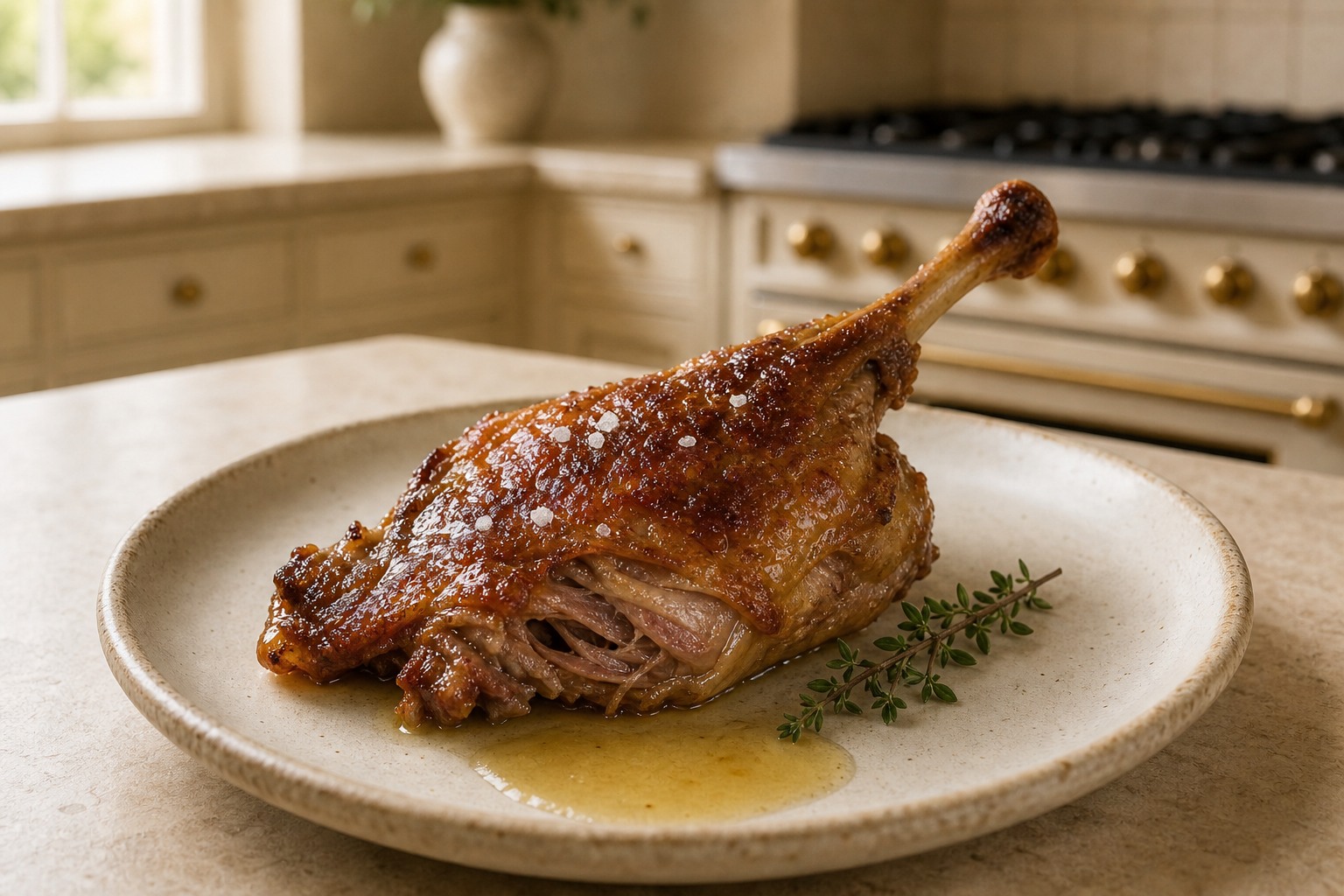

Confit describes slow cooking in fat as well as a historic preservation tradition. For a home kitchen, the useful distinction is between the cooking technique and safe storage: a layer of fat does not turn cooked duck or garlic into shelf-stable food. You can serve confit on the day it is cooked; a week of aging is not a requirement.
Correction, September 8, 2026: An earlier version recommended extended cellar storage, three months of refrigerated duck, and two weeks for garlic in oil. Those recommendations have been withdrawn. Follow the refrigeration and freezing guidance below.
What to plan before cooking
Choose a complete duck-confit recipe that specifies the weight and number of legs, seasoning, cooking temperature and method. Changing from a stovetop pot to an oven changes how heat reaches the fat. A temperature measured in the fat is not the temperature inside the thickest piece of meat. Nor does a fixed cooking time prove that every piece is ready.
Use an adequately sized, heat-safe vessel and enough space to move pieces without splashing hot fat. Keep water away from hot fat. Have a food thermometer, a clean tray for cooked food, and shallow storage containers ready before you start. Separate utensils and boards used for raw poultry from ready-to-eat food.
For poultry, check the thickest part of the meat away from bone for at least 165°F (74°C). Tenderness is a separate quality check: reaching the safety minimum does not guarantee a tender duck leg. These handling and temperature checks follow USDA guidance for duck and goose; they are not a claim that this publication has tested a particular confit recipe.
Choose the storage route at serving time
| Your plan | What to do | What the fat layer does not establish |
|---|---|---|
| Eat the duck today | Serve after cooking, with a crisping step if desired. | There is no mandatory seven-day wait. |
| Eat cooked duck within a few days | Cool promptly in shallow portions, refrigerate at 40°F (4°C) or below and use within 3–4 days. | Covering the meat with fat does not justify months in the refrigerator. |
| Keep cooked duck longer | Freeze promptly in meal-size portions. Label with the cooking date. | A cellar or pantry is not a substitute for a refrigerator or freezer. |
| Keep homemade garlic in oil | Refrigerate at 40°F (4°C) or below for no more than 4 days, or freeze for longer storage. | Cooking garlic in oil is not a validated shelf-stable preservation process. |
The duck storage window comes from USDA’s cooked-duck storage table. The garlic limit comes from the National Center for Home Food Preservation’s garlic-in-oil guidance, which identifies a botulism risk when garlic and oil are stored at room temperature.
Cooling a batch without a long counter rest
A large pot of food and fat is awkward to cool. Plan smaller, shallow portions instead of leaving the whole covered vessel on the counter until its center feels cool. Refrigerate perishable leftovers within two hours, or one hour when the surrounding temperature is above 90°F (32°C). Hot food can go directly into the refrigerator in appropriately divided containers; it does not need to reach room temperature first. See USDA’s cooling and reheating instructions.
Label each container with the date cooked and what it contains. If a batch is intended for several meals, package those meals separately so the whole batch does not repeatedly warm while portions are removed. Freezing earlier makes planning simpler than waiting until you are unsure how long a container has been in the fridge.
Crisping and reheating are different checks
A browned skin tells you about the surface. When reheating stored duck, check that the meat reaches 165°F (74°C), as recommended for leftovers by USDA. Adjust heat so the exterior does not burn before the center is hot. Start with a thawed portion and allow enough time for the meat to warm through; a fixed two-minute flip cannot guarantee that.
If the skin browns too quickly, reduce the surface heat and continue with a method that warms the center evenly. If the skin is pale but the meat is already hot, a brief finishing step may improve texture. These are different adjustments, so record both the internal reading and the surface result when choosing what to change next time.
Why garlic confit needs its own decision
Garlic in oil should not inherit a storage period from a duck recipe. The NCHFP’s guidance applies specifically to homemade garlic-in-oil mixtures: keep them refrigerated for at most four days or freeze. Make a small amount you can use within that window, and label both the garlic and any oil saved with it. An attractive jar or intact layer of oil is not evidence of safety.
Do not taste food to decide whether an uncertain storage history is acceptable. If you cannot establish when it was made or how it was held, discard it. Historical descriptions of preservation are cultural context, not a validated home-canning process.
Method note: This is a source-based cooking and storage guide, not a kitchen-tested recipe or a preservation procedure. The linked authorities support the safety limits; the planning checklist is editorial guidance for applying them at home.