
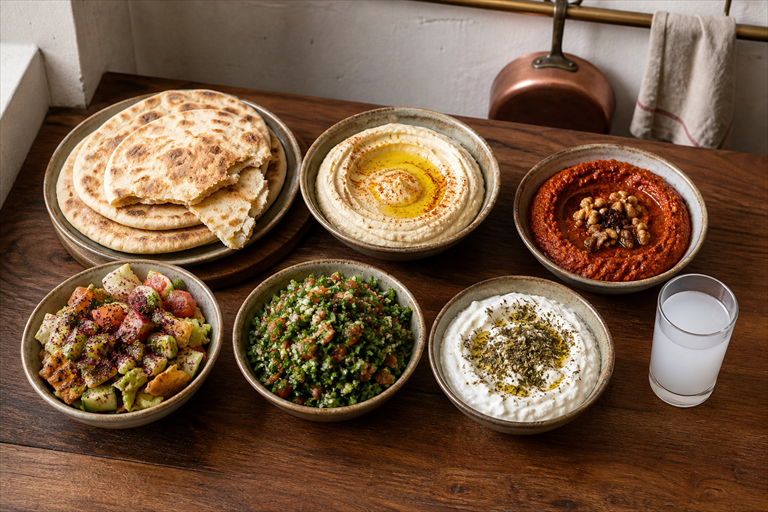
In Lebanon, a mezze table can be read the moment it is set. Cool white labneh sits beside a garnet muhammara, sumac dusted on chopped tomato, warm khubz stacked to one side. The anchoring technique is not a single spice mix. It is a balance grid: sour against fat, raw against cooked, cold against hot, applied across ten or twelve small plates. Mezze is not an appetiser course. It is the meal.
The practical question is a simple one. What separates a Lebanese mezze from a random spread of dips and salads? Sequence and ratio. A cook in Beirut is not choosing dishes by mood. They are filling slots in a grid, in a set order, with a bread-to-plate ratio and a pacing rhythm. That pacing keeps the table open for two or three hours without any single flavour taking over.
Mezze is a table, not an appetiser course
The word mezze comes from the Persian maza, meaning taste or relish, and travelled west through the Ottoman kitchens of the eastern Mediterranean. Anissa Helou, in Lebanese Cuisine (Grub Street, 1994), documents the Lebanese mezze as a refinement of an older Levantine practice of small shared plates. The result is denser, slower, and more theatrical than the Greek or Turkish equivalent.
In Lebanon the table is called the sofra. The host does not present a starter followed by a main. The sofra opens with a set of small dishes and stays open. Hot plates arrive in waves. Grilled meats, if they come at all, come after most guests have already eaten enough. The structure is horizontal rather than vertical.
The balance grid: the rule that governs everything
Every mezze table works on four opposing axes. A well-built spread scores at least one plate on each side of each axis. Miss an axis and the table feels flat within the first twenty minutes.
| Dish | Temperature | Fat vs acid | Raw vs cooked | Role on the table |
|---|---|---|---|---|
| Hummus | Cold | Fat | Cooked | Anchor dip |
| Baba ghanoush | Cold | Fat, smoked | Cooked | Second anchor, smoke |
| Muhammara | Cold | Fat, sweet-hot | Cooked | Aleppo-pepper counter-point |
| Labneh | Cold | Fat, cultured | Raw | Cooling bite |
| Tabbouleh | Cold | Acid | Raw | Herb and lemon brightness |
| Fattoush | Cold | Acid | Raw | Crunch, sumac, pomegranate molasses |
| Khodra (raw vegetables) | Cold | Neutral | Raw | Palate reset |
| Kibbeh (fried) | Hot | Fat | Cooked | Hot bite, bulgur and lamb |
| Makanek | Hot | Fat and acid | Cooked | Small lamb sausage |
| Batata harra | Hot | Acid, chilli | Cooked | Hot vegetable |
| Warak enab | Cold or hot | Acid | Cooked | Rolled bite |
| Kibbeh nayeh | Cold | Fat | Raw | Raw lamb ceremony |
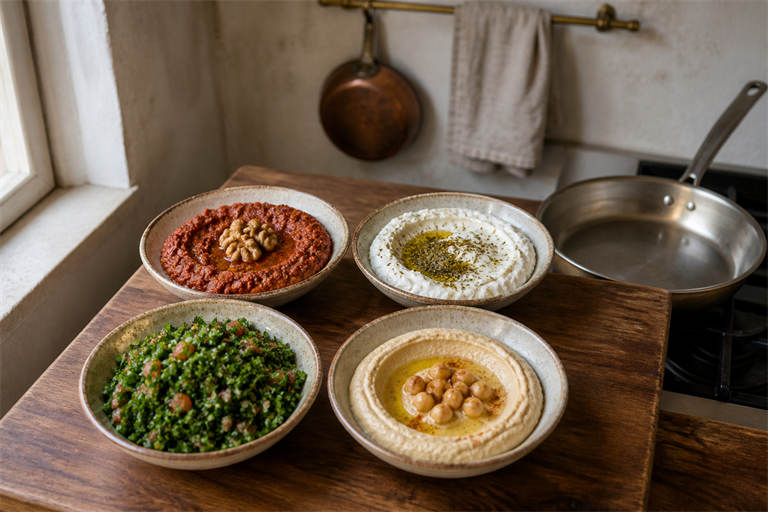
The grid also disciplines the shopping list. If two dips are already fat-forward and cooked, the third plate cannot be another cooked purée. It has to be raw, or acidic, or both. A Beirut cook filling twelve slots almost never repeats a texture in adjacent bowls.
Anchor dishes and their exact roles
Six or seven dishes recur on almost every Lebanese mezze table. They are anchors, and each does a specific job the others cannot.
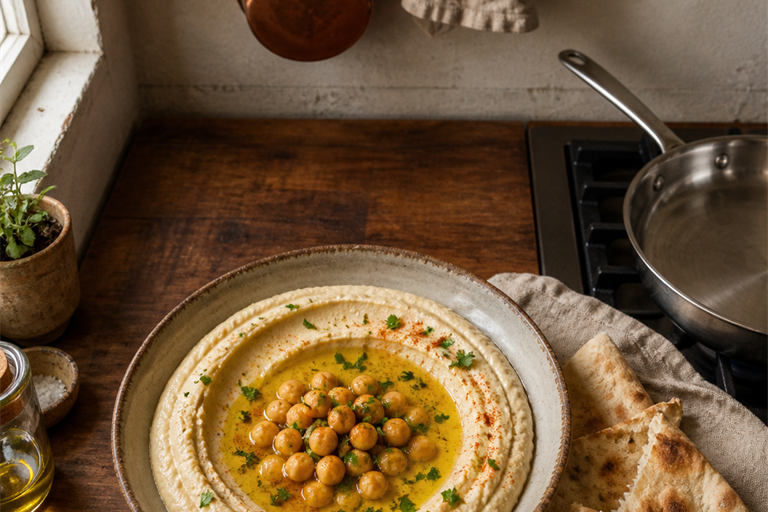
Hummus. The Beirut ratio runs roughly 250 g cooked chickpeas, 100 g tahini, 30 ml lemon juice, one small garlic clove, and salt. Ice water is whipped in until the paste is pale and pourable. Tahini is dominant, not chickpea. A stiff hummus is a sign the tahini was skimped.
Baba ghanoush (moutabbal). Eggplant blackened over open flame until the skin collapses, then drained, mashed with tahini, lemon, and garlic. Smoke is the point. Oven-roasted eggplant makes a different dish.
Tabbouleh. Overwhelmingly parsley. A traditional ratio runs 500 g flat-leaf parsley to 30–50 g fine bulgur, with tomato, mint, spring onion, lemon, and olive oil. Bulgur is a seasoning, not a base.
Fattoush. Chopped cucumber, tomato, radish, purslane if in season, torn toasted khubz, dressed with lemon, olive oil, sumac, and often a spoon of pomegranate molasses. Sumac and molasses give the acid its Lebanese signature.
Muhammara. Roasted red pepper, walnut, breadcrumb, Aleppo pepper, pomegranate molasses, cumin. The colour should be deep garnet, the flavour sweet-hot-sour in that order.
Labneh. Yogurt drained through cheesecloth for 12–24 hours until it holds its shape. Served with olive oil and dried mint. Its job is coolness, not flavour density.
Kibbeh and makanek. These carry the hot side. Fried kibbeh is a bulgur and lamb shell around spiced lamb and pine nuts. Makanek is a small lamb sausage flamed with lemon at the table.
Sequencing and pacing: what hits the table, and when
Order matters as much as the roster. A Lebanese host will bring plates in three waves.
- First wave, on sitting. Cold dips (hummus, baba ghanoush, muhammara, labneh), bread, raw vegetables, olives, pickled turnips. Everything arrives together. Guests eat immediately with bread. Arak is poured.
- Second wave, within ten minutes. Cold salads (tabbouleh, fattoush) and warak enab. The acid axis opens against the fat plates already on the table.
- Third wave, staggered over 30–60 minutes. Hot small plates: kibbeh, makanek, sujuk, batata harra, sometimes small skewers. They arrive two or three at a time, never all at once, so the table stays warm without ever piling up.
Grilled meat and rice, if they are served at all, come after most guests have already eaten. In many households they never appear. Mezze is not a prelude to a main. It is the structure the meal is built inside.
Bread, arak, and the etiquette of the shared plate
Khubz, the thin round Lebanese flatbread, is the utensil. It is torn with one hand, folded around a scoop of dip or a piece of kibbeh, and eaten in one bite. A well-run table keeps a fresh stack within arm’s reach at all times. When the stack thins, the host refills it before it empties.
Arak, the anise-based grape spirit, sits beside the water jug. A standard pour is one part arak to two parts water, added in that order so the drink turns milky white, then ice added last. The reverse order shocks the anise oils and clouds the flavour. Small glasses are refreshed often through the meal.
Two etiquette rules govern the shared plate. Dip once with each piece of bread, and do not return a used edge to a shared bowl. Do not rearrange the plates either. The host’s spacing is deliberate, and rebalancing the table is a small form of correction.
Building a home mezze for 2, 6, or 12
The grid scales cleanly. The plate count roughly doubles at each step, and one new axis-check is added at every size.
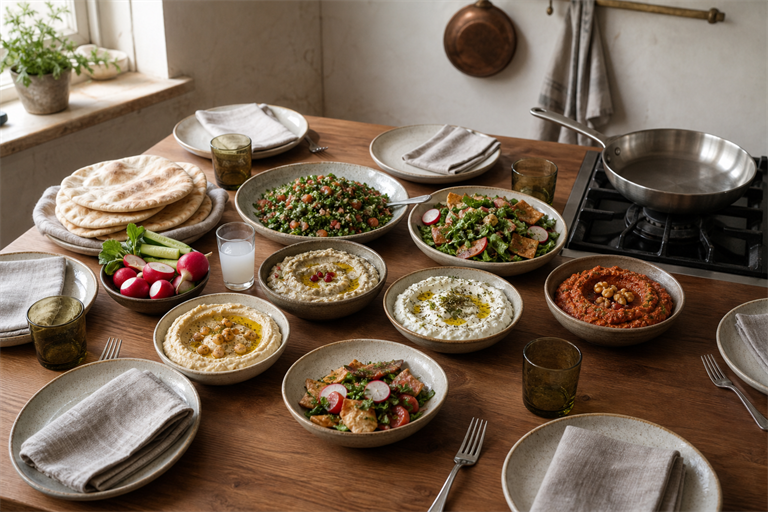
- Mezze for 2. Four plates. One cold dip (hummus), one salad (fattoush or tabbouleh), one hot small plate (four pieces of kibbeh, or a small pan of makanek), and a stack of bread. Arak, or a light dry white.
- Mezze for 6. Eight to ten plates. Two cold dips (hummus plus muhammara or baba ghanoush), one labneh, two salads (tabbouleh and fattoush), one raw vegetable plate, two hot plates (kibbeh with batata harra, or makanek with warak enab), bread refilled twice, arak.
- Mezze for 12. Twelve to sixteen plates. Three cold dips, labneh, three salads, raw vegetables, pickled turnip, three or four hot plates arriving in two waves thirty minutes apart, two bread stacks kept warm, arak and water in equal supply.
The case for the grid, and the case against it
The strongest argument for the grid is that it makes mezze legible outside Lebanon. Without it, a home cook can spend a day making six good dishes and still set down a flat table. Every plate ends up a cold cooked purée. Salma Hage, in The Lebanese Kitchen (Phaidon, 2012), organises her mezze chapter along these axes for exactly this reason. Home cooks who follow the ratios get a coherent spread the first time.
The argument against is that the grid can freeze into a checklist. Village mezze in the Bekaa or the Chouf will look nothing like a Beirut restaurant spread. Expect fewer plates, more raw vegetables, more pickles, sometimes a single cooked dish standing in for three. A rigid grid misses the seasonal, household version. The corrective is to treat the axes as balance rules rather than a menu.
What to take to your own table
Build the plate count from the grid down, not the recipes up. Fill the four axes first. Keep bread and arak at hand from the first plate. Bring hot plates in waves, and never let a bowl sit empty long enough to look finished.
Serve the mezze with warm khubz stacked on a folded linen. A glass of arak, clouded to its proper milky white, sits beside a bowl of ice and cold water. A small dish of pickled turnip and cured olives stays within reach until the last plate is cleared.